
In this article
- 1. Why Samarkand matters
- 2. The Registan — the heart of the city
- 3. Shah-i-Zinda — the avenue of mausoleums
- 4. Gur-e-Amir and Bibi-Khanym
- 5. Bazaars and daily life
- 6. When to visit Samarkand
- 7. Getting to Samarkand
- 8. Where to stay
- 9. Staying connected with an eSIM
- 10. Getting around the city
- 11. Muslim-friendly travel in Samarkand
- 12. Protecting your trip
- 13. Beyond Samarkand
Samarkand is one of the oldest continuously inhabited cities on earth, and for centuries it was the glittering heart of the Silk Road. Founded more than 2,500 years ago and reshaped by the conqueror Amir Timur (Tamerlane) into his imperial capital, it is a place where the scale of the architecture genuinely takes your breath away — vast turquoise domes, towering minarets and courtyards of intricate mosaic that seem to glow against the Central Asian sky. Today Samarkand is Uzbekistan's most visited destination, and it sits on a modern high-speed rail line that makes it remarkably easy to reach. This guide covers what to see, when to go, how to get there, where to stay, how to stay connected, and how to compare current offers from multiple travel brands in one place before completing your booking with a partner. Whether you have a single day between trains or a full week to explore, Samarkand rewards the journey.
Why Samarkand matters
Few cities carry the weight of history that Samarkand does. It was a crossroads of civilisations — Persian, Greek, Arab, Mongol and Turkic cultures all layered themselves here, and the result is a city that feels distinct from anywhere else in Central Asia. The monuments are not empty shells; they are living landmarks where locals still gather, pray and trade. The Registan, the great square at the city's heart, is one of the finest ensembles of Islamic architecture anywhere in the world, and standing in it at sunset is an experience that stays with you. Beyond the famous sites, Samarkand is also a working Uzbek city — markets piled with spices and silk, neighbourhoods of clay-walled houses, and tea houses where you can sit for hours over green tea and non bread. It is at once monumental and intimate, and that combination is what makes it so memorable.
The Registan — the heart of the city
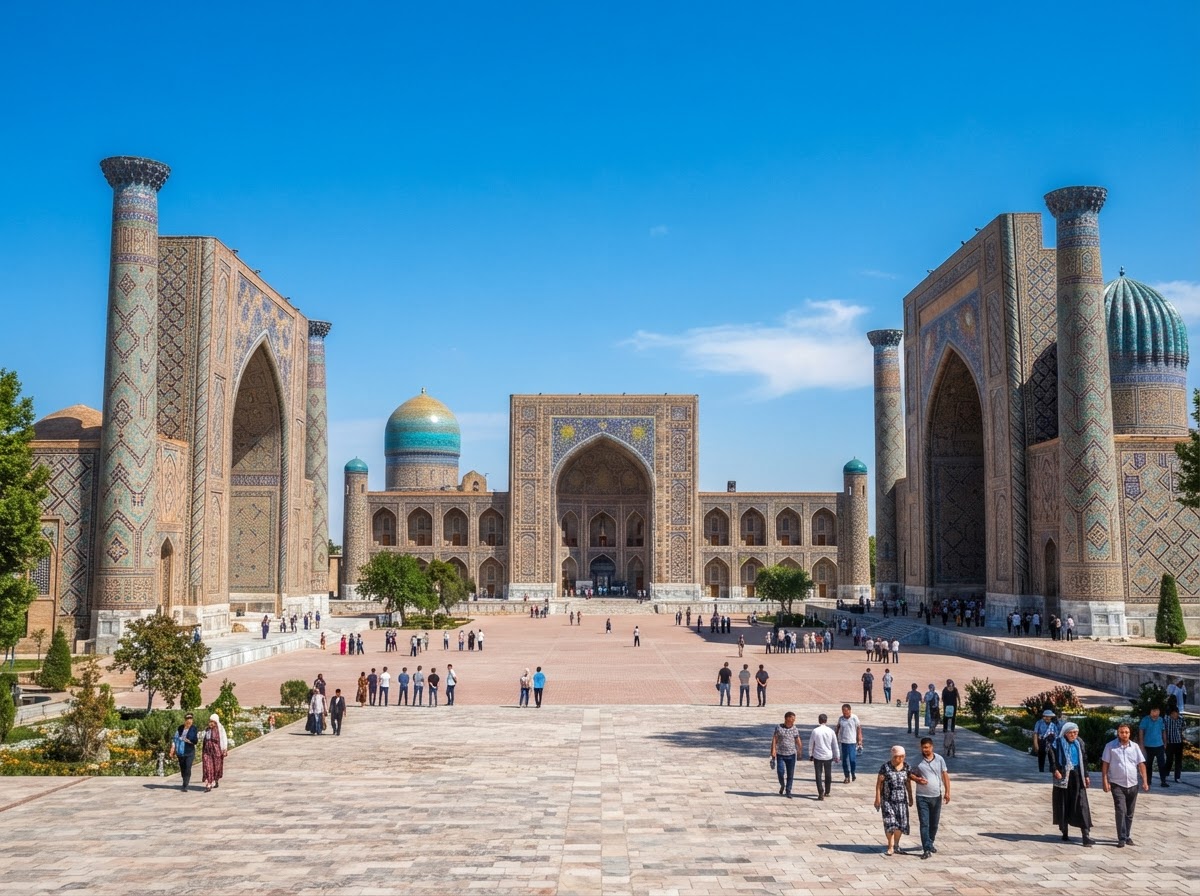
The Registan is the logical starting point for any visit. It is a vast public square framed on three sides by monumental madrasahs — the Ulugh Beg Madrasah (1417), the Sher-Dor Madrasah (1619) and the Tilya-Kori Madrasah (1646). Each is a masterpiece of tilework, with soaring pishtaq portals, geometric mosaics and lion motifs that were revolutionary for their time. The square is open and free to wander, though entering each madrasah requires a small ticket. Go at sunrise to have it almost to yourself, and return at dusk when the facades are lit and the light is at its most dramatic. The Registan also hosts occasional evening light-and-sound shows in summer, which are worth checking the local schedule for. Allow at least two hours to explore the three buildings and their courtyards properly.
Shah-i-Zinda — the avenue of mausoleums
If the Registan is Samarkand's most famous sight, Shah-i-Zinda is its most beautiful. This narrow avenue of intricately tiled mausoleums is one of the most stunning ensembles of medieval architecture in the Islamic world. The name means 'Living King' and refers to the legend that a cousin of the Prophet Muhammad is buried here, making it a place of pilgrimage for centuries. Walking the avenue is like walking through a gallery of ceramic art — each small mausoleum is covered in a different pattern of majolica, from deep blues to shimmering golds. Climb to the top of the avenue for a view back down the line of domes, and visit early or late in the day when the tiles catch the low sun. Shah-i-Zinda is a short taxi or marshrutka ride from the Registan, and is often combined with a visit to the nearby Bibi-Khanym Mosque.
Gur-e-Amir and Bibi-Khanym
The Gur-e-Amir is the mausoleum of Amir Timur himself, and it is a sobering, grand space — a fluted dome rising over a chamber that holds the tombs of Timur, his sons and his grandsons, including the astronomer-king Ulugh Beg. The interior is richly gilded, and the contrast between the dark chamber and the golden detail is striking. A few minutes' walk away, the Bibi-Khanym Mosque was once one of the largest mosques in the Islamic world, built by Timur for his favourite wife. Today its enormous pishtaq portal and the huge Quran stand that once held the world's largest Quran are the main draws, along with the sheer scale of the ruins. Both sites are within easy walking distance of the Registan, making a compact morning itinerary possible.
Bazaars and daily life
To balance the monuments, spend time in the Siab Bazaar, just behind the Bibi-Khanym Mosque. It is the city's main market and a feast for the senses — stalls of dried fruits, nuts, spices, fresh bread and the famous Samarkand non (round loaves stamped with patterns). This is where locals shop, and it is the best place to taste the real Samarkand: try plov (the rice and meat dish that is Uzbekistan's national dish), samsa (meat pastries baked in a tandoor) and the local green tea. Bargaining is expected on handicrafts, silk scarves and souvenirs, so negotiate politely. The bazaar is also a great place to buy Suzani embroidery — the hand-stitched wall hangings that are a specialty of the region — though check that what you are buying is genuinely hand-embroidered rather than machine-made.
When to visit Samarkand
The best times to visit are spring (April to early June) and autumn (September to early November), when the weather is mild and the light is beautiful. Summer (July and August) can be brutally hot, with daytime temperatures regularly above 40°C, though the monuments are quieter and the early-morning and evening hours are still pleasant. Winter (December to February) is cold and sometimes snowy, but the snow-dusted domes are magical and the crowds are minimal. Avoid the Navruz holiday period around 21 March if you dislike crowds, as it is the Persian New Year and a major celebration. Whenever you go, bring layers — the desert climate means hot days and cool nights even in spring and autumn.
Getting to Samarkand
Samarkand is easier to reach than many travellers expect. The modern Afrosiyob high-speed train connects Tashkent (the capital, where the main international airport is) to Samarkand in about 2 hours 10 minutes, with onward services to Bukhara and Urgench (for Khiva). The train is comfortable, punctual and the recommended way to travel between the major Silk Road cities — book in advance, especially in peak season, as seats sell out. If you are flying internationally, compare flights to Tashkent across providers, then take the train onward. For those who prefer road travel, private transfers and car hire are options for the Tashkent–Samarkand route or for exploring the wider region — compare transfer providers and car rental brands to find the right fit for your group and budget.
Where to stay
Samarkand has a growing range of accommodation, from Soviet-era hotels to newer boutique guesthouses built in traditional style. The most convenient area to stay is within walking distance of the Registan, so you can reach the main sights on foot and return to your hotel during the heat of the day. Many of the best boutique options are a short taxi ride from the centre in quieter residential streets, offering courtyards, local food and a more authentic atmosphere. Compare hotel options across booking platforms to find the right balance of location, price and style for your trip. If you are travelling the full Silk Road circuit (Tashkent–Samarkand–Bukhara–Khiva), plan at least two nights in Samarkand to see the main sights without rushing.
Staying connected with an eSIM
Uzbekistan's mobile networks have improved rapidly, and a travel eSIM is the simplest way to have data from the moment you arrive — no queuing at an airport kiosk or hunting for a local SIM shop. Compare data-only eSIMs across providers, checking coverage in Samarkand and along the rail corridor, data allowances and validity. A single-country plan is usually cheapest for a focused Uzbekistan trip; a regional or global plan is better value if you are combining Uzbekistan with neighbouring Central Asian countries. Remember that most travel eSIMs are data-only, so keep your home line active if you need to receive SMS verification codes, and download offline maps for Samarkand in case of any connection delay in the older parts of the city.
Getting around the city
Samarkand's main sights are spread across a few kilometres, so you will need some form of transport beyond walking. Taxis are cheap and plentiful — agree a price before you get in, or use a ride-hailing app where available. Marshrutkas (shared minibuses) run fixed routes and are very inexpensive, though they require a little local knowledge to use confidently. For the Registan, Shah-i-Zinda and Bibi-Khanym, a combination of walking and short taxi rides works well. If you want more independence to explore the surrounding countryside — including the ancient paper mill at Konigil or the Ulugh Beg observatory ruins — compare car rental options, and remember that driving in Uzbekistan requires an International Driving Permit and a sense of adventure.
Muslim-friendly travel in Samarkand
Uzbekistan is a Muslim-majority country, and Samarkand is a comfortable destination for Muslim travellers. Halal food is the norm rather than the exception — plov, samsa, laghman and shashlik are all halal by default in local restaurants, and finding halal dining is straightforward. Mosques are plentiful, with the Bibi-Khanym Mosque and the Hazrat-Hizr Mosque near the Registan among the most central for prayer. Prayer facilities are also available at most major monuments during opening hours. During Ramadan, be considerate of those fasting, though tourist services continue as normal. The city is family-friendly and safe, and the culture is welcoming to visitors. An eSIM helps you locate nearby mosques and halal restaurants on the go.
Protecting your trip
As with any international journey, it is worth considering travel insurance for medical emergencies, trip cancellations and lost baggage before you travel — compare policies from providers you trust and check what is actually included, particularly coverage for any adventure activities. If your flight to or from Tashkent is delayed, cancelled or overbooked, you may be entitled to compensation under applicable air passenger rights regulations, regardless of your ticket type. Specialist services can check your eligibility and handle the claim with the airline on your behalf, often on a no-win no-fee basis. Keep your boarding pass and booking reference until you are safely home, and review each provider's terms before using any service.
Beyond Samarkand
Samarkand is rarely a standalone destination — most travellers combine it with the other great Silk Road cities. Bukhara, about 1.5 hours further along the high-speed rail line, is an almost perfectly preserved medieval city of minarets, caravanserais and domed bazaars, and many travellers find it even more atmospheric than Samarkand. Khiva, further west, is a walled open-air museum of mud-brick architecture. Tashkent, the capital, offers modern infrastructure, excellent museums and the chorsu bazaar. If you have the time, the full Tashkent–Samarkand–Bukhara–Khiva circuit is one of the great overland journeys in Asia, easily done by train and private transfer. Compare flights, transfers and hotels across providers to build the route that works for your dates and budget.
Recommended Offers
Relevant offers for this trip. You'll be redirected to the partner to complete your booking.
Compare flights to Tashkent & Uzbekistan
Check PricePrivate transfer Tashkent to Samarkand
Check PriceTransfer with English-speaking driver
View AvailabilityCompare private transfer offers
Check PriceShared & private airport shuttles
View OfferUzbekistan eSIM (local data)
View DealUnlimited data eSIM with virtual number
View DealFlexible global data eSIM
View DealPrepaid data eSIM
View DealSamarkand tours & activities
View DealSkip-the-line attraction tickets
View OfferSilk Road day tours & experiences
View DealMulti-attraction sightseeing pass
View OfferSelf-guided audio walks
View OfferCar rental comparison in Uzbekistan
Check PriceCar rental marketplace
Check PriceCar hire with price-drop protection
Check PriceWorldwide car hire specialist
Check PriceRent the exact car you see
Check PriceScooter & motorbike rental
Check PriceSecure luggage storage
View DealFlight delay compensation check
Check EligibilityFlight cancellation compensation claim
Check EligibilitySome links may be affiliate links. JalanDeals may earn a commission when you book through selected partners.
Frequently Asked Questions
How do I get to Samarkand?
Most travellers fly into Tashkent, then take the Afrosiyob high-speed train to Samarkand (about 2 hours 10 minutes). Compare flights to Tashkent across providers, and book the train in advance as seats sell out in peak season.
How many days do I need in Samarkand?
Two full days is enough to see the Registan, Shah-i-Zinda, Gur-e-Amir, Bibi-Khanym and the Siab Bazaar at a relaxed pace. Add a third day if you want to visit out-of-town sites like the Konigil paper mill or the Ulugh Beg observatory.
When is the best time to visit Samarkand?
Spring (April to early June) and autumn (September to early November) offer mild weather and beautiful light. Summer is very hot, and winter is cold but quiet. Avoid the Navruz holiday around 21 March if you dislike crowds.
Which eSIM works in Uzbekistan?
Compare data-only eSIMs from Airalo, Yesim, Drimsim and Saily that cover Uzbekistan. A single-country plan is usually cheapest; a regional plan is better if you are combining Uzbekistan with neighbouring Central Asian countries.
Is Samarkand suitable for Muslim travellers?
Yes. Uzbekistan is a Muslim-majority country, halal food is the norm, mosques are plentiful (including the Bibi-Khanym and Hazrat-Hizr mosques near the Registan), and the city is safe and family-friendly.
Can I travel from Samarkand to Bukhara and Khiva?
Yes. The Afrosiyob high-speed train connects Samarkand to Bukhara in about 1.5 hours. For Khiva, take the train to Urgench then a short transfer. The full Tashkent–Samarkand–Bukhara–Khiva circuit is one of the great overland journeys in Asia.
What should I buy in the Samarkand bazaars?
Look for Suzani hand embroidery, silk scarves, dried fruits and nuts, and spices. Bargaining is expected on handicrafts. Check that embroidery is genuinely hand-stitched rather than machine-made before buying.
Explore more
Related destination hubs and deal categories for this trip.
Destinations
Deal categories
Affiliate disclosure: This article contains affiliate links. JalanDeals may earn a commission when you book through selected partners, at no additional cost to you. Prices and availability are set by the provider.