
In this article
- 1. Why Bali is so enduringly popular
- 2. Where to stay — choosing your base
- 3. The must-see temples
- 4. Rice terraces and the interior
- 5. Beaches and surf
- 6. Food and the cafe culture
- 7. When to visit Bali
- 8. Getting to Bali
- 9. Getting around Bali
- 10. Staying connected with an eSIM
- 11. Muslim-friendly travel in Bali
- 12. Protecting your trip
- 13. Beyond Bali
Bali is the island most travellers picture when they imagine Indonesia — a landscape of emerald rice terraces, volcanic peaks, surf-washed beaches and thousands of temples draped in colourful offerings. It is small enough to explore in a week yet varied enough to fill a month, with each region offering a distinctly different mood: the buzz of Seminyak and Canggu, the creative calm of Ubud, the cliff-edge drama of Uluwatu and the laid-back diving of the east coast. This guide covers what to see, where to base yourself, when to go, how to get around, how to stay connected and how to compare current offers from multiple travel brands in one place before completing your booking with a partner.
Why Bali is so enduringly popular
Bali's appeal is that it rewards every kind of traveller. Surfers come for the consistent reef breaks of the Bukit peninsula, families come for the calm beaches and waterparks of Sanur, honeymooners come for the clifftop sunsets of Uluwatu, and culture-seekers come for Ubud's temples, palaces and craft villages. Underneath all of that is a living Hindu tradition unique in the world's largest Muslim-majority country — every doorway has a small offering basket, every village has a temple, and ceremony days punctuate the calendar. The result is an island that feels both easy and exotic, which is why so many visitors return again and again.
Where to stay — choosing your base
Where you stay in Bali matters more than in most destinations because traffic can make short distances slow. Seminyak and Petitenget offer upscale resorts, beach clubs and dining in walkable clusters. Canggu is the surf-and-cafe capital, popular with digital nomads and younger travellers. Ubud, inland and cooler, is the cultural heart — rice terraces, yoga studios, art markets and temples. Uluwatu and the Bukit peninsula serve clifftop villas, surf breaks and dramatic sunsets. Sanur has a calmer, family-friendly reef beach. Nusa Dua is a purpose-built enclave of large resorts. Compare hotel options across booking platforms to find the right balance of location, price and style for your dates, and consider splitting your stay between two areas to see more of the island without long daily drives.
The must-see temples
Bali's temples (pura) are the soul of the island. Tanah Lot, perched on a rock in the sea, is the most photographed and is best at sunset. Uluwatu Temple sits on a dramatic cliff above the Indian Ocean and hosts a nightly Kecak fire dance as the sun goes down — book tickets in advance. Besakih, the 'mother temple', sprawls up the slopes of Mount Agung and is Bali's holiest complex. Tirta Empul is the water temple where Balinese come for ritual purification in its holy springs. Ulun Danu Beratan, on the shores of a crater lake, is misty and serene. Remember that temples require a sarong and sash (usually provided at the entrance), and that menstruating women are traditionally not permitted to enter — respect the local customs.
Rice terraces and the interior
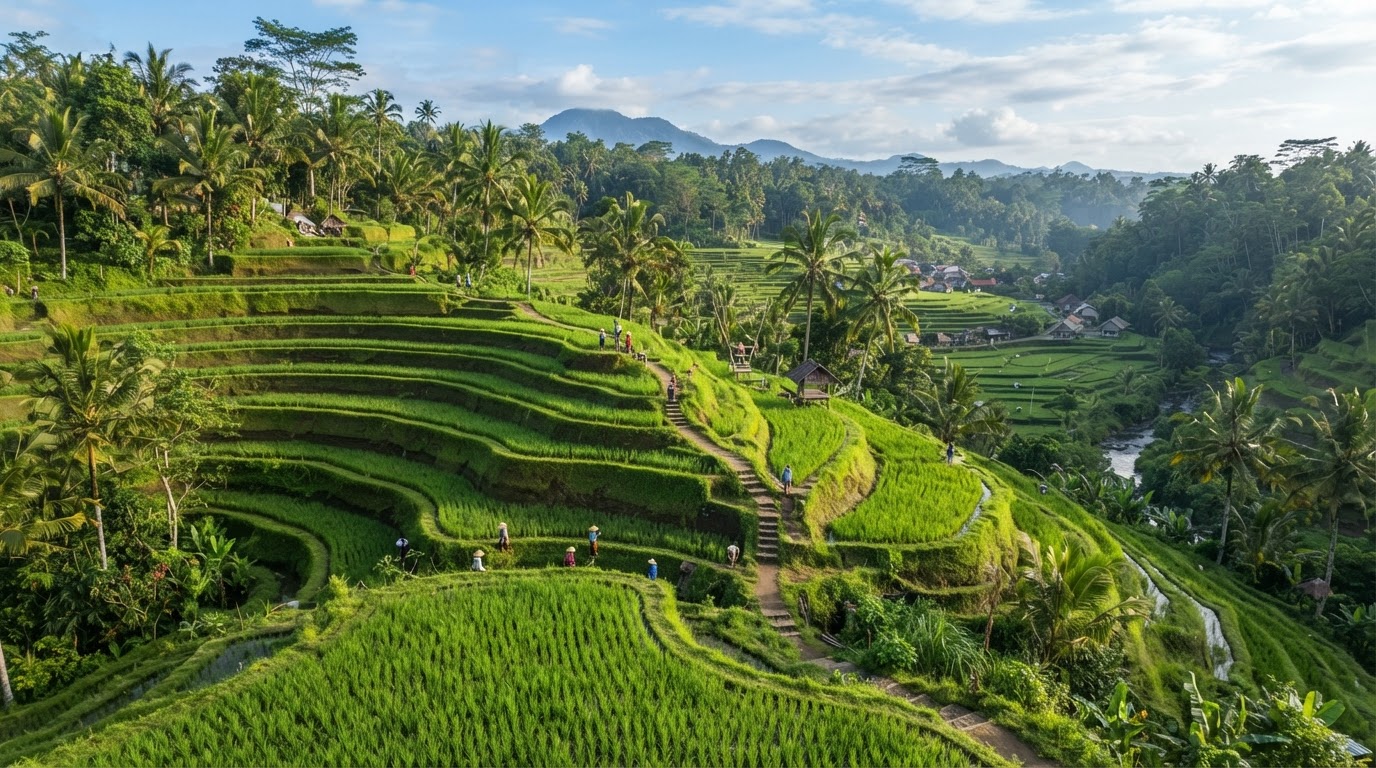
The Tegallalang Rice Terraces north of Ubud are the iconic image of Bali's interior, a sculpted landscape of palms and paddies that is best in the early morning before the crowds and the heat. For a quieter, more expansive version, head to the Jatiluwih terraces, a UNESCO-listed landscape that is genuinely vast and far less visited. The interior also offers waterfalls — Tegenungan is the easiest to reach, while Sekumpul is the most spectacular but requires a longer trek. Mount Batur is a popular sunrise hike, a two-hour pre-dawn climb to a volcanic ridge with views across to Mount Agung. Book a guided hike rather than going alone.
Beaches and surf
Bali's beaches vary enormously. Kuta is the long, busy beginner-surf beach closest to the airport — fun but crowded. Seminyak and Batu Bolong in Canggu are the trendy surf-and-beach-club beaches. Padang Padang on the Bukit is a powerful reef break for experienced surfers, and the small cove beside it is a lovely swimming spot. Balangan and Bingin are beautiful clifftop beaches with reef breaks. Nusa Dua has calm, protected sand ideal for swimming. Sanur's reef-protected beach is gentle and family-friendly. For snorkelling and diving, head east to Amed or take a boat to Nusa Penida for manta rays and the famous Kelingking Beach viewpoint.
Food and the cafe culture
Bali's food scene is one of its great pleasures. Warungs (small local eateries) serve nasi campur (rice with a selection of dishes), mie goreng, satay and babi guling (Balinese suckling pig) at very low prices. Ibu Oka in Ubud and Warung Babi Guling in Denpasar are famous for the latter. At the other end, Seminyak and Canggu have one of the world's best cafe and brunch scenes — smoothie bowls, specialty coffee and plant-based menus. For a splurge, try a beach club like Potato Head or a clifftop restaurant in Uluwatu. Halal food is widely available given Indonesia's Muslim majority, though babi guling is not halal — Muslim travellers will find plenty of options elsewhere.
When to visit Bali
Bali sits just south of the equator and has two seasons. The dry season runs from April to October, with May, June and September the sweet spots — sunny, lower humidity and fewer crowds than peak July-August. The wet season runs from November to March; rain usually falls in short heavy bursts rather than all day, and the island is lush and green, but roads can flood and some boat services are rougher. Avoid Nyepi (the Balinese Day of Silence, usually in March) if you need to travel, as the entire island including the airport shuts down for 24 hours. Christmas and New Year are busy and expensive. Whenever you go, pack reef-safe sunscreen and a light rain jacket.
Getting to Bali
Most international visitors fly into Ngurah Rai International Airport (DPS) in Denpasar, which has direct connections across Asia, Australia and the Middle East. Compare flights across providers to find the best fare and routing for your dates. The airport is in the south of the island, close to Kuta and Seminyak, so transfer times to the main resorts are short. If you are arriving late at night with luggage, a pre-booked private transfer is the most stress-free option — compare transfer providers for fixed-price meet-and-greet services. There is no rail network on Bali, so onward travel is by road.
Getting around Bali
Getting around Bali is the question that shapes most itineraries. The honest answer is that you need some form of wheels. Ride-hailing apps (Grab and Gojek) work well in the south but are restricted in some areas by local taxi cooperatives, so check coverage. Private drivers can be hired by the day and are excellent value for sightseeing. Scooter rental is ubiquitous and cheap, and is how most visitors get around Canggu and the Bukit — but only rent one if you are an experienced rider, have a valid licence, and have travel insurance that covers scooter accidents (many policies exclude them unless you hold a licence). For families or longer trips, compare car rental options. Traffic in the south can be heavy, so build in buffer time.
Staying connected with an eSIM
Indonesian mobile data is cheap and fast, and a travel eSIM is the easiest way to have it from the moment you land — no queuing at an airport kiosk. Compare data-only eSIMs across providers, checking coverage in the more remote parts of Bali (the interior and north coast can have weaker signal), data allowances and validity. A single-country Indonesia plan is usually cheapest; a regional Asia plan is better value if you are combining Bali with other Southeast Asian countries. Remember that most travel eSIMs are data-only, so keep your home line active if you need to receive SMS verification codes, and download offline maps for the interior.
Muslim-friendly travel in Bali
Although Bali itself is Hindu-majority, Indonesia is the world's largest Muslim-majority country, and Muslim travellers are very well catered for. Halal food is widely available across the island — look for halal certification or ask at warungs, and use halal-finder apps. Mosques (masjid) are found in every town, particularly in Denpasar and the Muslim-majority areas like Lovina in the north. Prayer facilities are available at the airport and major malls. When visiting temples, dress modestly (sarong and sash provided). Bali is safe and welcoming for Muslim families, and the island's halal dining scene has grown significantly in recent years.
Protecting your trip
Travel insurance is strongly recommended for Bali — medical care at international-standard hospitals can be expensive, and scooter accidents are common. Compare policies and check specifically that your cover includes any activities you plan (scooter riding, diving, hiking). If your flight to or from Bali is delayed, cancelled or overbooked, you may be entitled to compensation under applicable air passenger rights regulations regardless of your ticket type; specialist services can check your eligibility and handle the claim with the airline on your behalf. Keep your boarding pass and booking reference until you are safely home.
Beyond Bali
Bali is a great base for exploring more of Indonesia. Nusa Penida and the Nusa Lembongan islands are a fast boat away and offer spectacular cliffs, manta ray snorkelling and quiet beaches. Lombok, Bali's neighbour to the east, has quieter beaches, the mighty Mount Rinjani volcano and the Gili Islands with their car-free, turtle-rich waters. Java is a short flight or ferry away for Yogyakarta's temples and Jakarta's energy. Compare flights, transfers and hotels across providers to build the route that works for your dates and budget.
Recommended Offers
Relevant offers for this trip. You'll be redirected to the partner to complete your booking.
Flights to Bali
Check PriceTours & activities in Bali
View DealsAttraction tickets in Bali
View OfferExperiences & day tours in Indonesia
View DealsCity passes & multi-attraction tickets
View PassesSelf-guided audio walks in Bali
View OfferBali airport private transfer
Check PriceAirport transfer with English-speaking driver
View AvailabilityCompare airport transfer prices
Check PriceShared & private airport transfers
View OfferIndonesia eSIM data
View DealUnlimited Indonesia data eSIM
View DealFlexible global data eSIM
View DealPrepaid Indonesia data eSIM
View DealLuggage storage in Bali
View DealCar rental comparison in Indonesia
Check PriceCar rental across Indonesia
Check PriceCar hire with price-drop protection
Check PriceCar hire with AutoEurope
Check PriceLocal car rental in Indonesia
Check PriceScooter & motorbike rental
Check PriceFlight delay compensation check
Check EligibilityFlight compensation claim service
Check EligibilitySome links may be affiliate links. JalanDeals may earn a commission when you book through selected partners.
Frequently Asked Questions
How many days do I need in Bali?
Five to seven days is a good first trip — enough to combine a beach base in the south with a few days in Ubud and a day trip to the Bukit or Nusa Penida. Two weeks lets you explore the north and east coast too.
When is the best time to visit Bali?
May, June and September offer sunny, lower-humidity weather with fewer crowds than peak July-August. The wet season (November-March) is cheaper and greener but rainier. Avoid Nyepi (March) when the island shuts down.
Do I need a visa for Bali?
Indonesia offers visa-free or visa-on-arrival entry to many nationalities — check the official Indonesian immigration guidance for your passport before travel.
Is Bali safe for scooter rental?
Only if you are an experienced rider with a valid licence and insurance that covers scooters. Traffic is busy and accidents are common. If in doubt, hire a private driver by the day instead.
Is Bali Muslim-friendly?
Yes. Indonesia is the world's largest Muslim-majority country, halal food is widely available, and mosques are found across the island, particularly in Denpasar and the north coast.
Which eSIM works in Bali?
Compare data-only eSIMs from Airalo, Yesim, Drimsim and Saily that cover Indonesia. A single-country plan is cheapest; a regional plan is better if you are combining Bali with other Southeast Asian countries.
Explore more
Related destination hubs and deal categories for this trip.
Destinations
Deal categories
Affiliate disclosure: This article contains affiliate links. JalanDeals may earn a commission when you book through selected partners, at no additional cost to you. Prices and availability are set by the provider.