
In this article
- 1. Why Cairo overwhelms and rewards
- 2. The Pyramids of Giza and the Sphinx
- 3. The Egyptian Museum and the new Grand Museum
- 4. Islamic Cairo and the bazaars
- 5. Coptic Cairo and Old Cairo
- 6. The Nile and a felucca sail
- 7. The food — fuul, koshary and more
- 8. Where to stay
- 9. When to visit Cairo
- 10. Getting to Cairo
- 11. Getting around Cairo
- 12. Staying connected with an eSIM
- 13. Muslim-friendly travel in Cairo
- 14. Protecting your trip
- 15. Beyond Cairo
Cairo is the largest city in the Arab world and Africa, a teeming metropolis of 20 million people that has been a capital for more than a thousand years. It is chaotic, noisy, polluted and one of the most exhilarating cities on earth. On its edge stand the last surviving wonder of the ancient world, the Pyramids of Giza; at its heart lies the Nile, the river that made Egypt; and in between is a living medieval city of mosques, bazaars and the greatest collection of ancient Egyptian treasures in the world. This guide covers what to see, where to stay, when to go, how to get around, how to stay connected and how to compare current offers from multiple travel brands before completing your booking with a partner.
Why Cairo overwhelms and rewards
Cairo is not a city that eases you in. The traffic, the noise and the sheer density of people are intense, and the contrasts — ancient monuments beside modern flyovers, donkey carts beside Mercedes — are constant. But beneath the chaos is one of the oldest, richest, most hospitable cultures in the world. Egyptians are famously warm, the food is excellent and cheap, the history is unmatched, and the cost of visiting is low. Approach it with patience and a sense of humour, and it is one of the most rewarding cities you will ever visit.
The Pyramids of Giza and the Sphinx
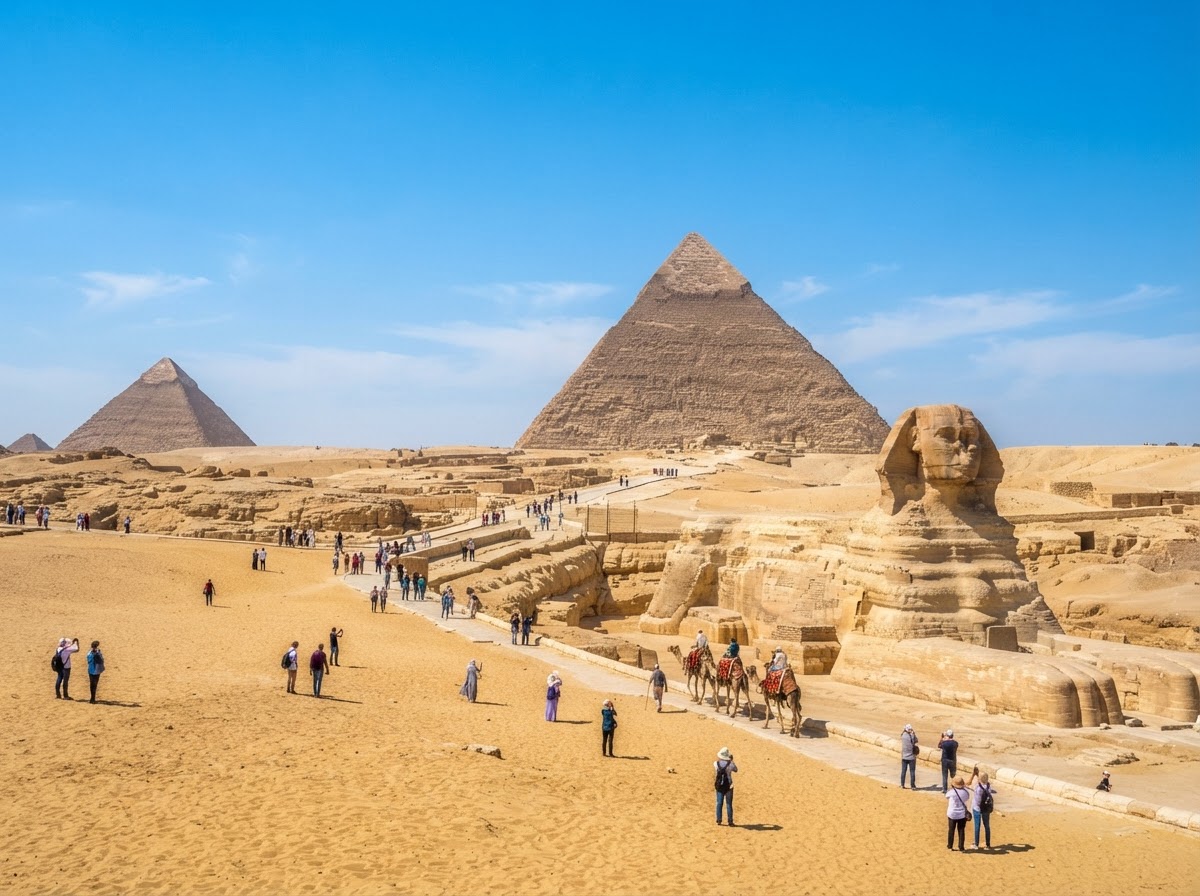
The Pyramids of Giza, on the edge of the city, are the last surviving wonder of the ancient world and the reason most visitors come to Egypt. The Great Pyramid of Khufu, built around 2560 BC, is the largest, and you can go inside it (a steep, hot climb to a bare chamber — not for the claustrophobic). The Pyramids of Khafre and Menkaure are beside it, and the Great Sphinx guards the complex. Go early in the morning to beat the heat and the crowds, and consider a guide to explain the context and to handle the persistent touts. A camel ride around the plateau at sunset is a memorable experience. The new Grand Egyptian Museum, nearby, is set to display the full Tutankhamun collection. Book tickets and tours in advance.
The Egyptian Museum and the new Grand Museum
The Egyptian Museum in Tahrir Square is the old museum, a cavernous, dusty, overwhelming building packed with the treasures of ancient Egypt — the Tutankhamun galleries (with the gold mask), the royal mummies, the statues and the everyday objects of 3,000 years of civilisation. It is being superseded by the Grand Egyptian Museum near the Pyramids, which will hold the full Tutankhamun collection in a modern setting, but the old museum remains worth a visit for its atmosphere and its sheer density. Allow a half-day and consider a guide to make sense of it. The Museum of Islamic Art and the Coptic Museum cover the other great periods of Egyptian history.
Islamic Cairo and the bazaars
Islamic Cairo is the medieval city, a UNESCO-listed area of mosques, madrasas, city gates and bazaars. The Mosque of Muhammad Ali, perched on the Citadel, is the most prominent, with a view over the whole city. The Sultan Hassan Mosque and the Al-Rifa'i Mosque are beside it. The Al-Azhar Mosque, founded in 970 AD, is one of the oldest universities in the world. Khan el-Khalili is the great bazaar — a maze of alleys selling spices, gold, copper, perfumes and souvenirs, with cafes where you can drink tea and smoke shisha. Wander it in the evening when it is most alive. The historic street of Al-Muizz is a beautiful open-air museum of Islamic architecture. Dress modestly in these areas.
Coptic Cairo and Old Cairo
Coptic Cairo, in the southern part of the old city, is the Christian heart of Cairo, where the Holy Family is said to have rested. The Hanging Church, built on top of a Roman gate, is the most beautiful. The Coptic Museum holds early Christian art. The Ben Ezra Synagogue is one of the oldest in Egypt. The area is quieter and more contemplative than Islamic Cairo, and the churches are open to visitors. Nearby, Old Cairo has the earliest layers of the city, including the Roman fortress of Babylon. The area is walkable and makes a good half-day contrast to the Islamic city.
The Nile and a felucca sail
The Nile is the river that created Egypt, and it runs through the heart of Cairo. A felucca, the traditional lateen-rigged sailboat, is the most peaceful way to see the city — a sunset sail on the Nile, with the city glowing on both banks, is one of the great Cairo experiences. Hire one at the docks near the Zamalek district or the Tahrir area. The Nile islands of Zamalek and Roda are leafy, upscale areas with galleries, cafes and the Cairo Tower, which offers a panoramic view of the city. A Nile dinner cruise is a more touristy but pleasant option. The river is the calm centre of a chaotic city.
The food — fuul, koshary and more
Egyptian food is hearty, cheap and excellent. Fuul (fava bean stew) and ta'ameya (Egyptian falafel, made from fava beans) are the national breakfast, eaten with bread. Koshary — a mix of rice, pasta, lentils, chickpeas, fried onions and tomato sauce — is the national comfort food, served at dedicated koshary shops. Molokhia (a green soup served with rice and meat) is a home classic. Hawawshy (meat-stuffed bread) and shawarma are street favourites. The fruit juices (sugarcane, mango) are wonderful. Eat at busy, high-turnover places. Egyptian food is overwhelmingly halal, given the Muslim majority, which makes Cairo an easy destination for Muslim travellers.
Where to stay
Downtown and Tahrir area put you near the Egyptian Museum and the Nile. Zamalek, the island district, is leafy, upscale and quieter. Giza, near the Pyramids, is convenient for the first or last morning. Islamic Cairo has atmospheric boutique hotels in restored houses. Compare hotel options across booking platforms to find the right balance of location, price and style for your trip, and note that Cairo's traffic is heavy, so staying near the sights you most want to see saves time.
When to visit Cairo
The best time is the cooler season, from October to April, when daytime temperatures are pleasant (20-25°C) and the nights are cool. December to February is the coolest and most comfortable. From May to September, temperatures regularly exceed 35°C and can hit 40°C+, making sightseeing exhausting — go very early in the morning. Avoid the major Egyptian holidays (Eid) if you dislike domestic crowds. Ramadan (dates vary) affects daytime dining, though tourist hotels continue to serve, and the iftar experience is wonderful. Whenever you go, the sun is strong, so bring a hat, sunscreen and water.
Getting to Cairo
Cairo International Airport (CAI) is the main hub for Egypt and is well connected across the Middle East, Africa and Europe. Compare flights across providers. The airport is on the eastern edge of the city; transfer times depend heavily on traffic. A pre-booked private transfer is the most reliable option, especially with luggage; compare transfer providers for fixed-price meet-and-greet services. Taxis are available but agree the fare in advance or use a ride-hailing app (Uber and Careem work in Cairo). The new metro line is expanding. Build in extra time for traffic.
Getting around Cairo
Cairo's traffic is legendary, so plan your time generously. The metro is cheap, fast and covers the main spine, though it can be very crowded. Ride-hailing apps (Uber, Careem) are the practical choice for most visitors — they are cheap and avoid the haggling of street taxis. Taxis are available but always agree the fare first. For the Pyramids, a booked tour or a ride-hailing car is the simplest option. Walking is possible in the old city areas but the traffic and the heat make it challenging. For trips beyond Cairo (to Alexandria, Luxor or Aswan), the train or a domestic flight is the way to go. Compare car rental options only if you are an experienced driver in the region.
Staying connected with an eSIM
Egypt has decent mobile data in the cities, though coverage can be patchy outside the main areas. A travel eSIM is the easiest way to have data from the moment you land. Compare data-only eSIMs across providers, checking coverage if you plan to travel beyond Cairo (to Luxor, Aswan or the Red Sea), data allowances and validity. A single-country Egypt plan is usually cheapest; a regional plan is better value if you are combining Egypt with neighbouring countries. Remember that most travel eSIMs are data-only, so keep your home line active for SMS verification codes, and download offline maps.
Muslim-friendly travel in Cairo
Cairo is one of the most Muslim-friendly cities in the world. Egypt is a Muslim-majority country, halal food is the norm across the city (finding non-halal food is harder than finding it), and mosques are everywhere — the Muhammad Ali Mosque, the Sultan Hassan Mosque and the Al-Azhar Mosque are architectural highlights. Prayer facilities are available at the airport and in most large hotels. During Ramadan, the city adapts: daytime eating in public is limited, but tourist hotels continue to serve, and the iftar meal after sunset is a wonderful communal experience. Dress modestly, especially in the old city and at religious sites. Cairo is safe, family-friendly and famously hospitable.
Protecting your trip
Travel insurance is recommended for Egypt — medical care at private facilities is good but can be expensive, and the heat and the crowds can be challenging. Compare policies and check what is included. If your flight to or from Cairo is delayed, cancelled or overbooked, you may be entitled to compensation under applicable air passenger rights regulations; specialist services can check your eligibility and handle the claim with the airline on your behalf. Keep your boarding pass and booking reference until you are home.
Beyond Cairo
Cairo is the gateway to the rest of Egypt. Luxor and Aswan, with the temples and tombs of ancient Egypt, are a short flight or an overnight Nile cruise away — one of the great travel experiences. Alexandria, the Mediterranean city, is a 2.5-hour train ride. The Red Sea resorts of Hurghada and Sharm El Sheikh offer diving and beaches. The Western Desert oases (Siwa, Bahariya) are for the adventurous. Compare flights, transfers, cruises and hotels across providers to build the route that works for your dates and budget.
Recommended Offers
Relevant offers for this trip. You'll be redirected to the partner to complete your booking.
Flights to Cairo
Check PriceTours & activities in Cairo
View DealsAttraction tickets in Cairo
View OfferExperiences & day tours in Egypt
View DealsCity passes & multi-attraction tickets
View PassesSelf-guided audio walks in Cairo
View OfferCairo airport private transfer
Check PriceAirport transfer with English-speaking driver
View AvailabilityCompare airport transfer prices
Check PriceShared & private airport transfers
View OfferEgypt eSIM data
View DealUnlimited Egypt data eSIM
View DealFlexible global data eSIM
View DealPrepaid Egypt data eSIM
View DealLuggage storage in Cairo
View DealCar rental comparison in Egypt
Check PriceCar rental across Egypt
Check PriceCar hire with price-drop protection
Check PriceCar hire with AutoEurope
Check PriceLocal car rental in Egypt
Check PriceScooter & motorbike rental
Check PriceFlight delay compensation check
Check EligibilityFlight compensation claim service
Check EligibilitySome links may be affiliate links. JalanDeals may earn a commission when you book through selected partners.
Frequently Asked Questions
How many days do I need in Cairo?
Two to three days is enough for the Pyramids, the Egyptian Museum, Islamic Cairo and a Nile felucca. Add days for Luxor and Aswan if you are doing the full Egypt circuit.
When is the best time to visit Cairo?
October to April is the cool, comfortable season. December-February is coolest. May-September is very hot (40°C+) — sightsee early in the morning. Ramadan affects daytime dining.
How do I get from Cairo airport to the city?
A pre-booked private transfer is most reliable. Ride-hailing apps (Uber, Careem) are cheap and avoid haggling. The metro is expanding. Build in extra time for traffic.
Is Cairo Muslim-friendly?
Very. Egypt is Muslim-majority, halal food is the norm, mosques are everywhere, and prayer facilities are at airports and hotels. Ramadan is a special time to visit.
Do I need a visa for Egypt?
Egypt offers visa-on-arrival or an e-visa to many nationalities — check the official Egyptian immigration guidance for your passport before travel.
Which eSIM works in Egypt?
Compare data-only eSIMs from Airalo, Yesim, Drimsim and Saily that cover Egypt. Coverage outside the main cities can be patchy, so download offline maps.
Explore more
Related destination hubs and deal categories for this trip.
Affiliate disclosure: This article contains affiliate links. JalanDeals may earn a commission when you book through selected partners, at no additional cost to you. Prices and availability are set by the provider.