
In this article
- 1. Why Cape Town is one of the great cities
- 2. Table Mountain and the natural sights
- 3. The V&A Waterfront and the city centre
- 4. Robben Island and the history
- 5. The Winelands
- 6. The beaches and the Cape Peninsula
- 7. Where to stay
- 8. When to visit Cape Town
- 9. Getting to Cape Town
- 10. Getting around Cape Town
- 11. Staying connected with an eSIM
- 12. Muslim-friendly travel in Cape Town
- 13. Protecting your trip
- 14. Beyond Cape Town
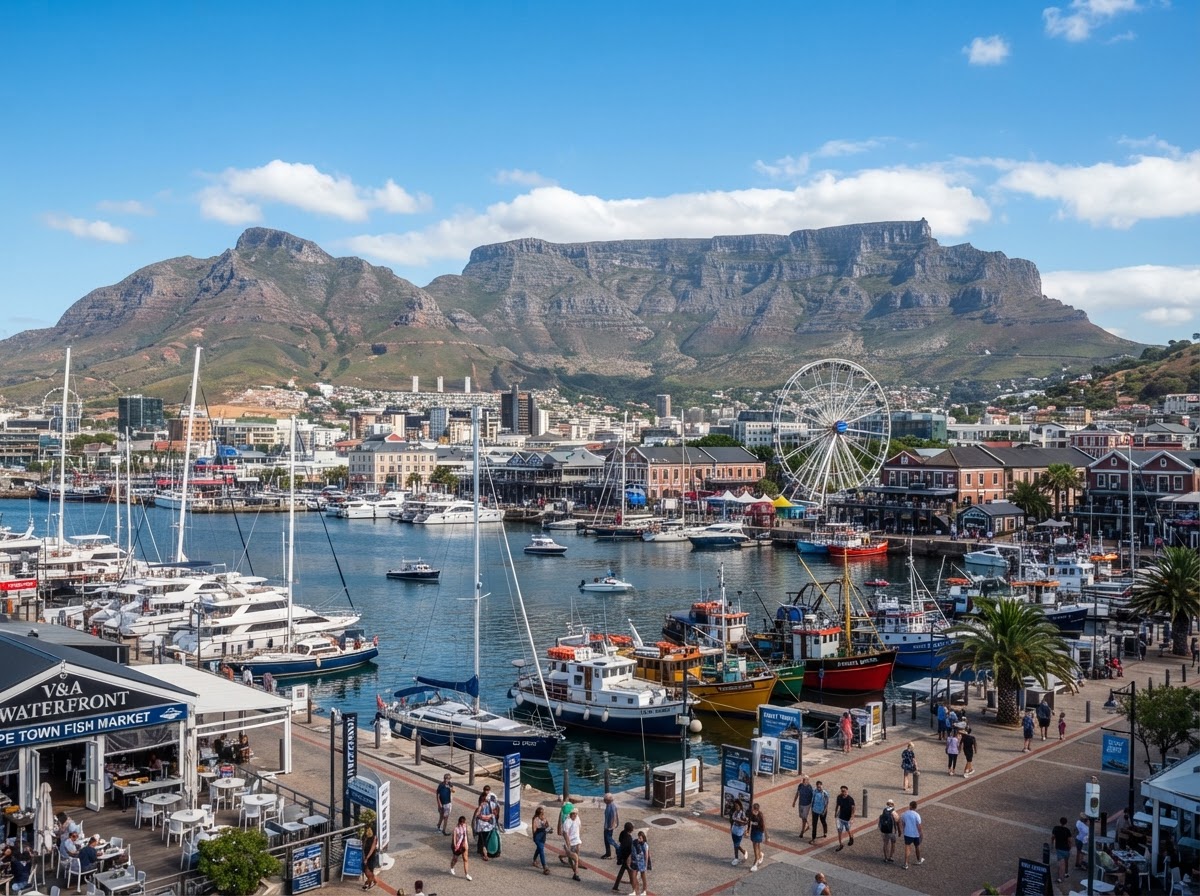
Cape Town is regularly voted one of the most beautiful cities in the world, and it is easy to see why. It is framed by Table Mountain, a flat-topped giant that rises a kilometre above the city, with the Atlantic Ocean on one side and a string of white-sand beaches on the other. It is a city of neighbourhoods — the historic centre, the working waterfront, the wine country a short drive away, and the townships that tell the harder story of South Africa. It is also the gateway to the Cape, the Garden Route and the wider country. This guide covers what to see, where to stay, when to go, how to get around, how to stay connected and how to compare current offers from multiple travel brands before completing your booking with a partner.
Why Cape Town is one of the great cities
Cape Town's setting is extraordinary — a city wrapped around a mountain, between two oceans, with a climate that is Mediterranean and a light that photographers love. But it is more than its setting. It is a city of real cultural depth: a Malay Quarter with a history older than the country itself, a wine industry founded in the 17th century, a design and food scene that is globally recognised, and a complex recent history told at Robben Island and in the city's museums. It is also a practical, affordable base for exploring one of the most beautiful countries on earth.
Table Mountain and the natural sights
Table Mountain is the defining feature, and you should go up it — by cable car (which rotates as it climbs) or, for the fit, by hiking the Platteklip Gorge trail. The view from the top over the city, the ocean and the Cape is one of the great city views. Go in the morning when it is clear (the mountain 'tablecloth' of cloud can obscure the view). Lion's Head, the peak beside it, offers a shorter, steeper hike and a 360-degree view, especially popular at full moon. For a different perspective, drive or take the Chapman's Peak drive along the Atlantic coast to Hout Bay and on to the Cape of Good Hope, the dramatic headland where (symbolically) two oceans meet. Boulders Beach, on the way, has a colony of African penguins.
The V&A Waterfront and the city centre
The V&A Waterfront, the redeveloped working harbour, is the tourist heart of Cape Town — shops, restaurants, the Two Oceans Aquarium, the Zeitz MOCAA contemporary art museum (in a converted grain silo) and the departure point for Robben Island ferries. It is safe, walkable and pleasant, with live music and a craft market. The city centre (the CBD) has Company's Garden, the South African Museum and the colourful Bo-Kaap, the Malay Quarter of pastel-painted houses. Long Street is the backpacker and nightlife strip. Greenmarket Square is the craft market. The District Six Museum tells the story of the forced removals under apartheid. The city is compact and walkable in the centre.
Robben Island and the history
Robben Island, where Nelson Mandela was imprisoned for 18 years, is a UNESCO World Heritage site and a moving half-day trip. The ferry departs from the V&A Waterfront (book in advance — it sells out, and trips are weather-dependent). The tour is led by former political prisoners, which gives it an extraordinary authenticity, and includes Mandela's cell and the quarry where the prisoners worked. Back in the city, the District Six Museum, the Slave Lodge and the Iziko museums tell the wider story of Cape Town's complex history. The Bo-Kaap, with its Cape Malay community, is a living piece of that history. These sites are essential to understanding the city beyond its beauty.
The Winelands
The Cape Winelands, about an hour's drive from the city, are one of the world's great wine regions and a beautiful day trip or overnight. Stellenbosch is the historic university town at the centre, surrounded by estates. Franschhoek, in a valley, is the gourmet capital with a wine tram that runs between estates. Paarl has the largest wine cellar in the world. Constantia, on the edge of the city, is the oldest wine region in the southern hemisphere. The estates offer tastings, restaurants (some world-class) and beautiful settings of Cape Dutch architecture and mountains. Book a tour or drive yourself; compare tour options across providers. The Winelands are a highlight of any Cape Town trip.
The beaches and the Cape Peninsula
Cape Town has spectacular beaches, though the Atlantic water is cold year-round. Camps Bay and Clifton are the glamorous white-sand beaches with palm-lined promenades and sunset cocktails. Llandudno is the local surf beach. Boulders Beach has the penguins. Muizenberg, on the False Bay side (warmer water), is the beginner surf beach with its colourful huts. The Cape Peninsula drive — through Hout Bay, over Chapman's Peak, to the Cape of Good Hope and Cape Point — is one of the great coastal drives. The Cape Point Nature Reserve has wildlife (ostrich, baboon, eland) and dramatic cliffs. Allow a full day for the peninsula loop.
Where to stay
The V&A Waterfront and the city centre are the most convenient for first-time visitors — walkable to restaurants, the waterfront and the ferry. Camps Bay and Clifton offer beachfront luxury with sunset views. Green Point and De Waterkant are central and lively. The Bo-Kaap and Gardens are atmospheric and central. The Winelands offer country-house hotels for a different pace. Compare hotel options across booking platforms to find the right balance of location, price and style for your trip, and note that Cape Town is spread out, so a location near the sights you most want to see or near the city centre saves time.
When to visit Cape Town
Cape Town has a Mediterranean climate, opposite to the northern hemisphere. The best time is the summer, from November to March, when it is warm and dry (25-30°C) and the beaches are at their best — this is peak season. Spring (September-October) and autumn (April-May) are pleasant and quieter. Winter (June-August) is cool, wet and windy, but the whales arrive in Hermanus (a day trip) and the wine estates are quiet and cosy. Avoid the South African school holidays (especially December-January) if you dislike crowds. Whenever you go, the weather can change quickly, so pack layers.
Getting to Cape Town
Cape Town International Airport (CPT) is the main airport, about 20 minutes from the city centre. Compare flights across providers — Cape Town is well connected across Africa, the Middle East and Europe, with some direct flights from other continents. A pre-booked private transfer is the most convenient option if you have luggage or a group; compare transfer providers for fixed-price meet-and-greet services. Taxis and ride-hailing apps (Uber) are available and reasonably priced. MyCiTi buses cover parts of the city. There is no city rail link from the airport.
Getting around Cape Town
Cape Town is spread out, so you need some form of transport. The MyCiTi bus system is good for the city centre, the Atlantic seaboard and some suburbs. Ride-hailing apps (Uber) are cheap, reliable and the practical choice for most visitors. Taxis are available. The Metrorail commuter train runs along the southern suburbs to Simon's Town (a scenic ride, but check safety advice). For the Winelands, the Cape Peninsula and the wider region, a car is the best option — compare car rental options; driving is on the left, on good roads, and gives you the freedom to explore. For longer trips (the Garden Route, the Eastern Cape), a car or a domestic flight is the way to go.
Staying connected with an eSIM
South Africa has good mobile data in the cities and along the main routes, though coverage in rural areas can be patchy. A travel eSIM is the easiest way to have data from the moment you land. Compare data-only eSIMs across providers, checking coverage if you plan to travel beyond Cape Town (into the Winelands, the Garden Route or the Eastern Cape), data allowances and validity. A single-country South Africa plan is usually cheapest; a regional plan is better value if you are combining South Africa with neighbouring countries. Download offline maps for the rural areas. Remember that most travel eSIMs are data-only, so keep your home line active for SMS verification codes.
Muslim-friendly travel in Cape Town
Cape Town has a significant Muslim community — the Cape Malay community, descended from Southeast Asian slaves and political exiles brought by the Dutch, is one of the oldest Muslim communities in the world. The Bo-Kaap is the historic heart, with several mosques. Halal food is widely available, especially Cape Malay cuisine (a unique blend of Malay, Dutch and Indian influences — try the bobotie, the bredie and the koeksisters), and the city's large Malay and Indian communities mean halal restaurants are common. Mosques are found across the city, particularly in the Bo-Kaap and the southern suburbs. Halal-finder apps are helpful. Prayer facilities are available at the airport. Cape Town is diverse and welcoming.
Protecting your trip
Travel insurance is recommended for South Africa — medical care at private facilities is excellent but can be expensive. Compare policies and check what is included. Cape Town, like any major city, requires normal urban awareness — keep valuables out of sight, avoid walking alone at night in unlit areas, and use ride-hailing apps rather than walking after dark. If your flight to or from Cape Town is delayed, cancelled or overbooked, you may be entitled to compensation under applicable air passenger rights regulations; specialist services can check your eligibility and handle the claim with the airline on your behalf. Keep your boarding pass and booking reference until you are home.
Beyond Cape Town
Cape Town is the gateway to the wider Cape and South Africa. The Garden Route, the scenic coastal drive to Port Elizabeth, is a classic road trip. Hermanus offers whale-watching in season. The Cape Agulhas, the southern tip of Africa, is a day trip. Johannesburg, the Kruger National Park (for safari) and the Drakensberg mountains are a short flight away. The rest of southern Africa — Namibia, Botswana, Zimbabwe (Victoria Falls) — is reachable by flight or overland. Compare flights, transfers, tours and hotels across providers to build the route that works for your dates and budget.
Recommended Offers
Relevant offers for this trip. You'll be redirected to the partner to complete your booking.
Flights to Cape Town
Check PriceTours & activities in Cape Town
View DealsAttraction tickets in Cape Town
View OfferExperiences & day tours in South Africa
View DealsCity passes & multi-attraction tickets
View PassesSelf-guided audio walks in Cape Town
View OfferCape Town airport private transfer
Check PriceAirport transfer with English-speaking driver
View AvailabilityCompare airport transfer prices
Check PriceShared & private airport transfers
View OfferSouth Africa eSIM data
View DealUnlimited South Africa data eSIM
View DealFlexible global data eSIM
View DealPrepaid South Africa data eSIM
View DealLuggage storage in Cape Town
View DealCar rental comparison in South Africa
Check PriceCar rental across South Africa
Check PriceCar hire with price-drop protection
Check PriceCar hire with AutoEurope
Check PriceLocal car rental in South Africa
Check PriceScooter & motorbike rental
Check PriceFlight delay compensation check
Check EligibilityFlight compensation claim service
Check EligibilitySome links may be affiliate links. JalanDeals may earn a commission when you book through selected partners.
Frequently Asked Questions
How many days do I need in Cape Town?
Four to five days is a good first trip — enough for Table Mountain, the waterfront, Robben Island, the Cape Peninsula and the Winelands. A week lets you add the Garden Route.
When is the best time to visit Cape Town?
November to March is the warm, dry summer (peak season). Spring and autumn are pleasant and quieter. Winter (June-August) is cool and wet but good for whales and wine estates.
How do I get from Cape Town airport to the city?
The airport is about 20 minutes from the centre. A pre-booked private transfer is easiest with luggage; Uber and taxis are available and reasonably priced.
Is Cape Town Muslim-friendly?
Yes. The Cape Malay community is one of the oldest Muslim communities in the world, the Bo-Kaap is its heart, halal food is widely available (try Cape Malay cuisine), and mosques are common.
Do I need a visa for South Africa?
South Africa offers visa-free entry to many nationalities for stays up to 90 days — check the official South African immigration guidance for your passport before travel.
Which eSIM works in South Africa?
Compare data-only eSIMs from Airalo, Yesim, Drimsim and Saily that cover South Africa. Coverage in rural areas can be patchy, so download offline maps for the Winelands and Garden Route.
Explore more
Related destination hubs and deal categories for this trip.
Affiliate disclosure: This article contains affiliate links. JalanDeals may earn a commission when you book through selected partners, at no additional cost to you. Prices and availability are set by the provider.