
In this article
- 1. Why Hanoi rewards the slow traveller
- 2. The Old Quarter
- 3. Temples and the French quarter
- 4. The street food capital
- 5. Ha Long Bay and Lan Ha Bay
- 6. The northern highlands
- 7. When to visit Hanoi
- 8. Getting to Hanoi
- 9. Getting around Hanoi
- 10. Staying connected with an eSIM
- 11. Muslim-friendly travel in Hanoi
- 12. Protecting your trip
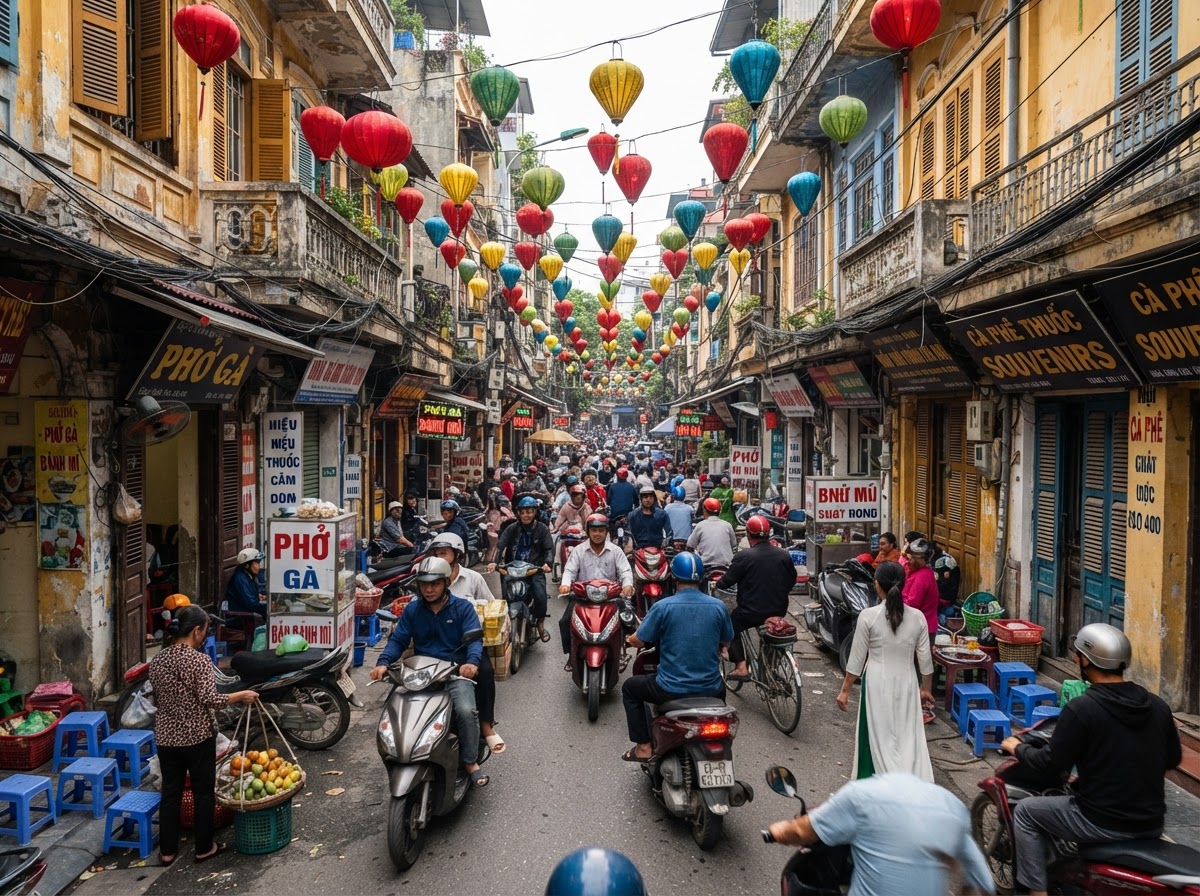
Hanoi is the older, more atmospheric of Vietnam's two great cities — a place of tree-lined boulevards, French colonial facades, glittering temples and a street-food culture that ranks among the best in the world. Its Old Quarter is a dense grid of 36 guild streets where each lane once sold a single trade, and today it hums with scooters, food stalls and tiny shops. Just beyond the city lies Ha Long Bay, the iconic seascape of limestone karsts, and the rice terraces and ethnic minority villages of the northern highlands. This guide covers what to see, where to stay, when to go, how to get around, how to stay connected and how to compare current offers from multiple travel brands before completing your booking with a partner.
Why Hanoi rewards the slow traveller
Hanoi is not a city you rush through. Its charm is in the details — the woman selling pho from a tiny plastic stool at dawn, the train street where the railway brushes past living-room doorways, the lake where locals practise tai chi at sunrise. Compared to Ho Chi Minh City's modern buzz, Hanoi feels older, more literary and more northern. The pace is slower, the winters are cool, and the food is more delicate. Give it at least three full days, and you will find it is one of the most rewarding cities in Southeast Asia.
The Old Quarter
The Old Quarter is the heart of Hanoi and where most visitors base themselves. Its 36 streets are organised by the trades that once defined them — Hang Bac (silver), Hang Bo (baskets), Hang Dao (silk). Today they are a dense, walkable maze of shop-houses, cafes, bia hoi (fresh beer) corners and food stalls. Walk it early in the morning when it is quiet, and again in the evening when it is at its most alive. Hoan Kiem Lake anchors the southern edge, with the red-painted The Huc bridge leading to Ngoc Son Temple on its island. The lake is the city's living room — locals gather here at dawn and dusk.
Temples and the French quarter
South of the lake, the French Quarter offers wide boulevards, colonial villas, the Opera House and some of the city's best cafes. The Temple of Literature, founded in 1070 as a university, is Hanoi's most beautiful complex — a series of courtyards dedicated to Confucius and the scholars who studied there. The One Pillar Pagoda, rebuilt after the French withdrawal, is a tiny but iconic temple rising from a lotus pond. Ho Chi Minh's mausoleum sits in a vast square and is a solemn, much-visited site (check opening hours and dress rules). For a quieter temple, visit Tran Quoc, the oldest pagoda in the city, on the shore of West Lake.
The street food capital
Hanoi is arguably the best street-food city in Southeast Asia, and eating well here costs very little. Pho is the breakfast of choice — try the beef pho at Pho Gia Truyen or Pho Bat Dan. Bun cha is grilled pork with noodles and herbs, made famous when Barack Obama ate it with Anthony Bourdain at Bun Cha Huong Lien (now nicknamed 'Obama bun cha'). Banh mi, the French-Vietnamese baguette sandwich, is best at Banh Mi 25. Cha ca (turmeric fish with dill) is a Hanoi specialty at Cha Ca Thang Long. Egg coffee (cà phê trứng), invented during a milk shortage, is a must at Cafe Giang. Eat where the locals eat — small plastic stools, no menu, big queue.
Ha Long Bay and Lan Ha Bay
The headline day trip from Hanoi is Ha Long Bay, the UNESCO-listed seascape of around 1,600 limestone islands rising from the Gulf of Tonkin. The classic experience is an overnight cruise on a traditional junk, sleeping on the water and waking to mist over the karsts. Day trips are possible but involve a 2.5-hour drive each way, so an overnight is far better value. Increasingly, travellers choose neighbouring Lan Ha Bay, which shares the same geology but has fewer boats. Compare cruise and tour options across providers before booking, and check what is included (meals, kayaking, transfers). Avoid the rainy and typhoon-prone months of July-August if you can.
The northern highlands
Beyond Ha Long, the northern highlands offer some of Vietnam's most dramatic scenery. Sapa, reached by overnight train or a long day drive, is the base for trekking among terraced rice fields and ethnic minority Hmong and Dao villages. The rice terraces are most beautiful when flooded (April-May) or golden before harvest (September-October). Ha Giang, further north, is the loop route for serious riders — limestone peaks, deep valleys and the Dong Van Karst Plateau. For these trips, a guided tour or a rented motorbike with experience is essential; compare tour operators and, if riding, ensure you have a valid licence and insurance that covers it.
When to visit Hanoi
Hanoi has four distinct seasons, unlike the south of Vietnam. Autumn (September to November) is the loveliest time — cool, dry, with clear skies and the best light. Spring (March to April) is pleasant but can be drizzly. Summer (May to August) is hot, humid and wet, with heavy downpours. Winter (December to February) is surprisingly cool, sometimes down to 10°C, with grey skies and a drizzle the locals call 'nồm' — pack a warm layer. For Ha Long Bay, avoid the July-August typhoon season when cruises can be cancelled. Whenever you go, the street food is year-round.
Getting to Hanoi
Noi Bai International Airport (HAN) is about 45 minutes from the Old Quarter. Compare flights across providers — Hanoi is well connected across Asia, and is often cheaper to fly into than Ho Chi Minh City. A pre-booked private transfer is the easiest way into town, especially with luggage; compare transfer providers for fixed-price options. Taxis are available but agree the fare or ensure the meter is used. There is no city rail link, though a metro line is expanding. For onward travel, the overnight train to Sapa (Lao Cai) departs from Ga Hanoi station in the Old Quarter.
Getting around Hanoi
The Old Quarter is walkable, though you must be alert to scooters on the pavements and crossings — the trick is to walk at a steady, predictable pace and let the traffic flow around you. Ride-hailing apps (Grab) work well and are cheap for short hops. Cyclos (cycle rickshaws) are a tourist experience rather than practical transport. For day trips, a private driver or a booked tour is the simplest option. If you rent a scooter, do so only if you are experienced — Hanoi traffic is dense and chaotic, and many travel insurance policies exclude scooters without a valid licence. Compare car rental options if you plan to explore the north independently.
Staying connected with an eSIM
Vietnam's mobile networks are fast and cheap, and a travel eSIM is the easiest way to have data from the moment you land. Compare data-only eSIMs across providers, checking coverage in the northern highlands (Sapa and Ha Giang can have patchy signal), data allowances and validity. A single-country Vietnam plan is usually cheapest; a regional Southeast Asia plan is better value if you are combining Vietnam with neighbouring countries. Remember that most travel eSIMs are data-only, so keep your home line active for SMS verification codes, and download offline maps for the highlands before you leave Hanoi.
Muslim-friendly travel in Hanoi
Vietnam is not a Muslim-majority country, but Hanoi has a small Muslim community and halal options are available with a little planning. There are a handful of halal restaurants near the Old Quarter and around Hoan Kiem Lake, and the Hanoi Mosque on Hang Luoc Street serves the local community. Halal-finder apps are helpful, and many Indian and Middle Eastern restaurants are halal-certified. Seafood and vegetarian Vietnamese dishes are easy to find and naturally suitable. Prayer facilities are limited outside the mosque, so plan prayer times around your hotel. An eSIM helps you locate halal restaurants on the go.
Protecting your trip
Travel insurance is recommended for Vietnam — medical care at international-standard clinics can be expensive, and scooter and trekking accidents do happen. Compare policies and check that your cover includes any activities you plan (trekking, riding, cruising). If your flight to or from Hanoi is delayed, cancelled or overbooked, you may be entitled to compensation under applicable air passenger rights regulations; specialist services can check your eligibility and handle the claim with the airline on your behalf. Keep your boarding pass and booking reference until you are home.
Recommended Offers
Relevant offers for this trip. You'll be redirected to the partner to complete your booking.
Flights to Hanoi
Check PriceTours & activities in Hanoi
View DealsAttraction tickets in Hanoi
View OfferExperiences & day tours in Vietnam
View DealsCity passes & multi-attraction tickets
View PassesSelf-guided audio walks in Hanoi
View OfferHanoi airport private transfer
Check PriceAirport transfer with English-speaking driver
View AvailabilityCompare airport transfer prices
Check PriceShared & private airport transfers
View OfferVietnam eSIM data
View DealUnlimited Vietnam data eSIM
View DealFlexible global data eSIM
View DealPrepaid Vietnam data eSIM
View DealLuggage storage in Hanoi
View DealCar rental comparison in Vietnam
Check PriceCar rental across Vietnam
Check PriceCar hire with price-drop protection
Check PriceCar hire with AutoEurope
Check PriceLocal car rental in Vietnam
Check PriceScooter & motorbike rental
Check PriceFlight delay compensation check
Check EligibilityFlight compensation claim service
Check EligibilitySome links may be affiliate links. JalanDeals may earn a commission when you book through selected partners.
Frequently Asked Questions
How many days do I need in Hanoi?
Three full days in the city plus an overnight Ha Long Bay cruise is the ideal first trip. Add two to three days for Sapa if you want the highlands.
When is the best time to visit Hanoi?
Autumn (September-November) is the loveliest season — cool, dry and clear. Spring (March-April) is pleasant. Summer is hot and wet; winter is cool and grey. Avoid July-August for Ha Long Bay due to typhoons.
Is Ha Long Bay worth it?
Yes, but take an overnight cruise rather than a day trip — the 2.5-hour drive each way makes a day trip exhausting. Lan Ha Bay next door has the same karst scenery with fewer boats.
Do I need a visa for Vietnam?
Vietnam offers e-visas to most nationalities — check the official Vietnamese immigration portal for your passport before travel.
Is Hanoi Muslim-friendly?
With planning, yes. There are a few halal restaurants and the Hanoi Mosque on Hang Luoc Street. Halal-finder apps and Indian/Middle Eastern restaurants help; seafood and vegetarian dishes are easy.
Which eSIM works in Vietnam?
Compare data-only eSIMs from Airalo, Yesim, Drimsim and Saily that cover Vietnam. Coverage in the northern highlands can be patchy, so download offline maps.
Explore more
Related destination hubs and deal categories for this trip.
Deal categories
Affiliate disclosure: This article contains affiliate links. JalanDeals may earn a commission when you book through selected partners, at no additional cost to you. Prices and availability are set by the provider.