
In this article
- 1. What makes Kuala Lumpur distinctive
- 2. The Petronas Twin Towers and the skyline
- 3. The food capital of Southeast Asia
- 4. Batu Caves and the temples
- 5. Markets, malls and the kampung
- 6. Where to stay
- 7. When to visit Kuala Lumpur
- 8. Getting to Kuala Lumpur
- 9. Getting around Kuala Lumpur
- 10. Staying connected with an eSIM
- 11. Muslim-friendly travel in Kuala Lumpur
- 12. Protecting your trip
- 13. Beyond Kuala Lumpur
Kuala Lumpur is Southeast Asia's great multicultural capital — a city where the call to prayer from a mosque, the bells of a Hindu temple and the incense of a Chinese temple can all be heard within a few blocks of each other. It is a skyline city, defined by the silver Petronas Twin Towers, but its real life is at street level: hawker stalls serving some of the best food in the region, leafy suburbs, vibrant markets and a mix of Malay, Chinese and Indian cultures that gives the city its character. This guide covers what to see, where to stay, when to go, how to get around, how to stay connected and how to compare current offers from multiple travel brands before completing your booking with a partner.
What makes Kuala Lumpur distinctive
KL (as everyone calls it) is a genuinely multicultural city in a way few capitals are. Malays, Chinese and Indians are the three largest communities, and the food, festivals, architecture and worship of each are woven through the city. It is modern and developed — efficient metro, glittering malls, world-class hotels — yet it keeps its street life and its hawker culture. It is also one of the most Muslim-friendly cities in the region, which makes it an easy and comfortable destination for Muslim travellers. The combination of development and street-level authenticity is what makes it special.
The Petronas Twin Towers and the skyline
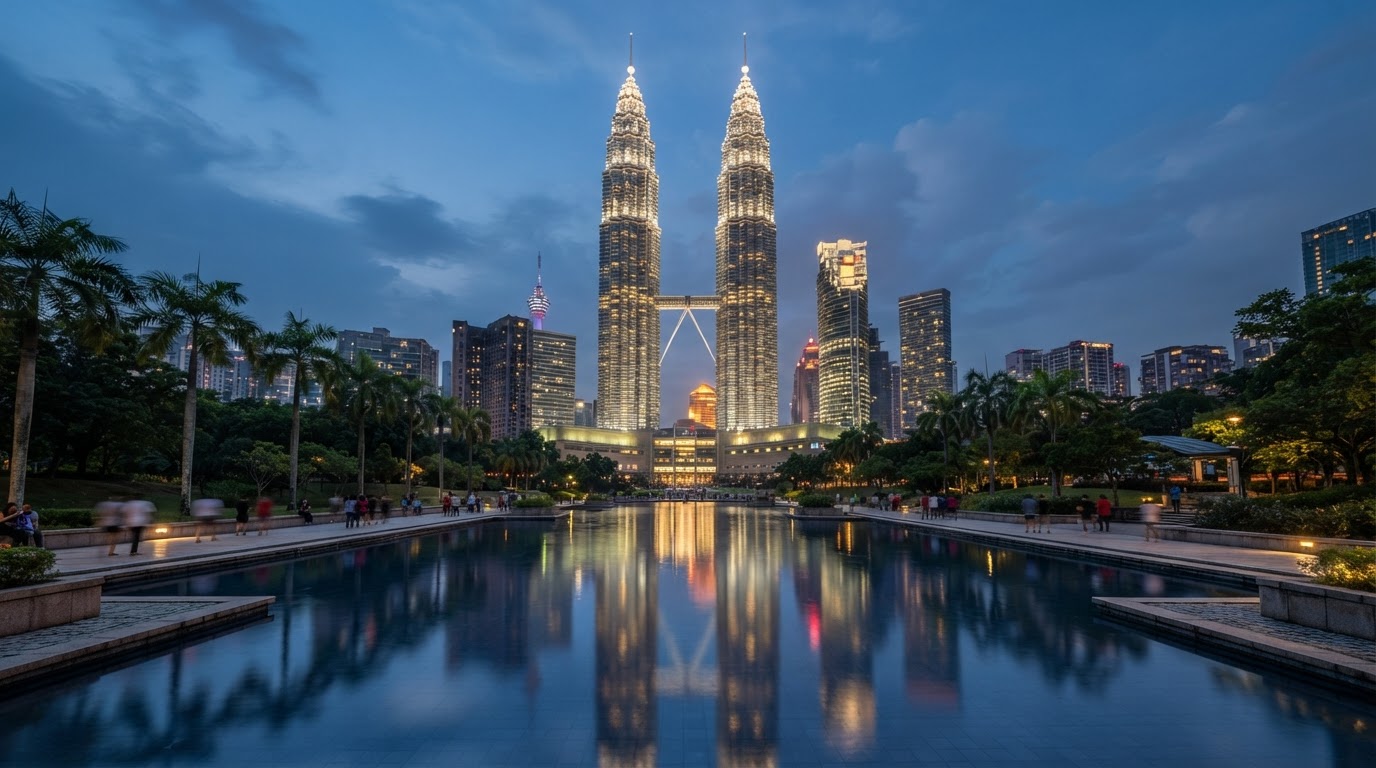
The Petronas Twin Towers were the tallest buildings in the world from 1998 to 2004 and remain the tallest twin towers. The skybridge on the 41st floor and the observation deck on the 86th are the headline experience — book in advance as tickets are limited and sell out. For the best view of the towers themselves (rather than from them), head to the KLCC Park at the base, or the Skybar at Traders Hotel. The Menara KL Tower on Bukit Nanas hill offers a different, higher perspective over the city. At night the towers are lit and reflected in the lake in the park — the classic KL photograph.
The food capital of Southeast Asia
KL is arguably the best eating city in Southeast Asia, and the best food is the cheapest. Jalan Alor in Bukit Bintang is the famous tourist food street, but for the real thing head to a hawker centre or a mamak stall. Nasi lemak (coconut rice with sambal, fried chicken, egg and peanuts) is the national dish — try it at Village Park in Damansara. Roti canai with dhal at a 24-hour mamak stall is a KL institution. Char kway teow, hokkien mee and bak kut teh are the Chinese-Malaysian specialties. For Indian food, head to Brickfields (Little India) or the banana-leaf restaurants in Bangsar. The street food is overwhelmingly halal, given the Muslim majority.
Batu Caves and the temples
Batu Caves, about 13km north of the city, is one of the most popular day trips. A huge golden statue of Lord Murugan stands at the base of 272 rainbow-painted steps leading up to a Hindu temple cave. The climb is hot but rewarding, and the cathedral-like main cave is impressive. Watch out for the macaques — they are bold and will grab food and loose items. Nearby, the Ramayana Cave has colourful dioramas. Back in the city, the Thean Hou Temple is a beautiful six-tiered Chinese temple with views over the city, and the Masjid Jamek sits at the confluence of the two rivers where KL began. The National Mosque (Masjid Negara) is open to non-Muslim visitors outside prayer times with provided robes.
Markets, malls and the kampung
KL is a city of contrasts — air-conditioned mega-malls beside street markets. Pavilion, Suria KLCC and Mid Valley are the headline malls. For markets, Central Market is the tourist-oriented crafts and art hub in a beautiful art-deco building; Petaling Street in Chinatown is the place for fake watches, herbalists and street food at night; and the weekend Taman Connaught night market in Cheras is huge and local. For a break from the city, the Bukit Nanas Forest Reserve is a pocket of rainforest right in the centre, with canopy walks among the trees. The Lake Gardens (Perdana Botanical Gardens) offer a large green space with the KL Bird Park and the National Mosque.
Where to stay
Bukit Bintang is the tourist heart — walkable to malls, food streets and the monorail, with options from hostels to five-star hotels. KLCC (around the Petronas Towers) is the upscale business and shopping district. Chinatown and around Pudu offer cheaper, more atmospheric options. Bangsar and Mid Valley are pleasant, leafier residential areas with great food and good transport links. Compare hotel options across booking platforms to find the right balance of location, price and style for your trip, and note that KL's traffic can be heavy at rush hour, so staying near an LRT or MRT station makes a big difference.
When to visit Kuala Lumpur
KL is hot and humid year-round, with temperatures around 30°C every day. It rains throughout the year, but the wettest months are typically March-April and October-November, when afternoon thunderstorms can be heavy but usually brief. The driest months are June to August. There is no bad time to visit, but avoid the major holiday periods if you dislike crowds: Chinese New Year (January-February), Hari Raya (dates vary with the Islamic calendar) and Deepavali. The towers and malls are air-conditioned, so rain is rarely a major disruption.
Getting to Kuala Lumpur
Kuala Lumpur International Airport (KUL) at Sepang is about 60km south of the city. It has two terminals — KLIA (full-service carriers) and KLIA2 (low-cost carriers). The KLIA Ekspres train is the fastest way into the city, reaching KL Sentral in about 30 minutes. Compare flights across providers — KL is a major hub with connections across Asia, the Middle East and Europe. A pre-booked private transfer is the most convenient option if you have luggage or a group; compare transfer providers for fixed-price meet-and-greet services. Taxis and ride-hailing apps are also available.
Getting around Kuala Lumpur
KL has an excellent and expanding public transport network — the LRT, MRT, monorail and commuter trains cover most of the city and are cheap, air-conditioned and efficient. Buy a Touch 'n Go card or use a contactless bank card to tap in and out. Ride-hailing apps (Grab) are cheap and reliable for shorter trips or when the trains do not reach. Driving yourself is not recommended for visitors — the traffic and the motorbike density make it stressful. For trips beyond the city (to Malacca, the Cameron Highlands or Penang), compare car rental options or take a bus or train.
Staying connected with an eSIM
Malaysia has fast, cheap mobile data, and a travel eSIM is the easiest way to have it from the moment you land. Compare data-only eSIMs across providers, checking coverage if you plan to travel beyond KL into the highlands or the east coast (where signal can be patchier), data allowances and validity. A single-country Malaysia plan is usually cheapest; a regional Southeast Asia plan is better value if you are combining KL with neighbouring countries. Remember that most travel eSIMs are data-only, so keep your home line active for SMS verification codes.
Muslim-friendly travel in Kuala Lumpur
KL is one of the most Muslim-friendly cities in Asia. Malaysia is a Muslim-majority country, so halal food is the norm rather than the exception — the vast majority of hawker stalls, mamaks and restaurants are halal-certified or Muslim-owned, and finding halal dining is effortless. Mosques are plentiful, with the National Mosque, Masjid Jamek and the blue-domed Federal Territory Mosque among the most beautiful. Prayer facilities are available at airports, malls and most large hotels. The city is family-friendly, safe and welcoming, and alcohol is available in hotels and bars for non-Muslim visitors but is not part of the mainstream culture.
Protecting your trip
Travel insurance is recommended for Malaysia — medical care at private hospitals is good but can be expensive. Compare policies and check what is included. If your flight to or from KL is delayed, cancelled or overbooked, you may be entitled to compensation under applicable air passenger rights regulations; specialist services can check your eligibility and handle the claim with the airline on your behalf. Keep your boarding pass and booking reference until you are safely home.
Beyond Kuala Lumpur
KL is a great hub for exploring Malaysia. Malacca (Melaka), a UNESCO-listed colonial port, is a two-hour bus or a short drive away and makes a wonderful day trip or overnight. The Cameron Highlands offer tea plantations and cooler air. Penang, with Georgetown's street art and food, is a short flight or a longer drive. Langkawi offers beaches and duty-free islands. Across the South China Sea, Malaysian Borneo (Sabah and Sarawak) offers wildlife, rainforest and Mount Kinabalu. Compare flights, transfers and hotels across providers to build the route that works for your dates and budget.
Recommended Offers
Relevant offers for this trip. You'll be redirected to the partner to complete your booking.
Flights to Kuala Lumpur
Check PriceTours & activities in Kuala Lumpur
View DealsAttraction tickets in Kuala Lumpur
View OfferExperiences & day tours in Malaysia
View DealsCity passes & multi-attraction tickets
View PassesSelf-guided audio walks in Kuala Lumpur
View OfferKuala Lumpur airport private transfer
Check PriceAirport transfer with English-speaking driver
View AvailabilityCompare airport transfer prices
Check PriceShared & private airport transfers
View OfferMalaysia eSIM data
View DealUnlimited Malaysia data eSIM
View DealFlexible global data eSIM
View DealPrepaid Malaysia data eSIM
View DealLuggage storage in Kuala Lumpur
View DealCar rental comparison in Malaysia
Check PriceCar rental across Malaysia
Check PriceCar hire with price-drop protection
Check PriceCar hire with AutoEurope
Check PriceLocal car rental in Malaysia
Check PriceScooter & motorbike rental
Check PriceFlight delay compensation check
Check EligibilityFlight compensation claim service
Check EligibilitySome links may be affiliate links. JalanDeals may earn a commission when you book through selected partners.
Frequently Asked Questions
How many days do I need in Kuala Lumpur?
Two to three days is enough for the towers, Batu Caves, the main markets and the best food. Add a day for Malacca if you have time.
When is the best time to visit Kuala Lumpur?
KL is hot and humid year-round. June to August is driest; March-April and October-November are wetter with afternoon storms. Avoid major holidays (Chinese New Year, Hari Raya) if you dislike crowds.
How do I get from KL airport to the city?
The KLIA Ekspres train reaches KL Sentral in about 30 minutes. A pre-booked private transfer is easiest with luggage; taxis and ride-hailing are also available.
Is Kuala Lumpur Muslim-friendly?
Very. Malaysia is Muslim-majority, halal food is the norm, mosques are plentiful, and prayer facilities are available at airports, malls and hotels.
Do I need a visa for Malaysia?
Malaysia offers visa-free entry to many nationalities for stays up to 90 days — check the official Malaysian immigration guidance for your passport before travel.
Which eSIM works in Malaysia?
Compare data-only eSIMs from Airalo, Yesim, Drimsim and Saily that cover Malaysia. A single-country plan is cheapest; a regional plan is better if you are combining Malaysia with neighbouring countries.
Explore more
Related destination hubs and deal categories for this trip.
Affiliate disclosure: This article contains affiliate links. JalanDeals may earn a commission when you book through selected partners, at no additional cost to you. Prices and availability are set by the provider.