
In this article
- 1. Why Las Vegas is the entertainment capital
- 2. The Strip and the mega-resorts
- 3. The shows and the entertainment
- 4. Downtown and Fremont Street
- 5. The Grand Canyon and the desert
- 6. Where to stay
- 7. When to visit Las Vegas
- 8. Getting to Las Vegas
- 9. Getting around Las Vegas
- 10. Staying connected with an eSIM
- 11. Muslim-friendly travel in Las Vegas
- 12. Protecting your trip
Las Vegas is a city like no other — an oasis of neon, casinos and spectacle in the Mojave Desert, where a replica of the Eiffel Tower sits beside a replica of the Venice canals, where the world's biggest shows play nightly, and where the Grand Canyon is a day trip. It is a city of excess and entertainment, but it is also a gateway to some of the most dramatic desert and canyon landscapes in the world. This guide covers what to see, where to stay, when to go, how to get around, how to stay connected and how to compare current offers from multiple travel brands before completing your booking with a partner.
Why Las Vegas is the entertainment capital
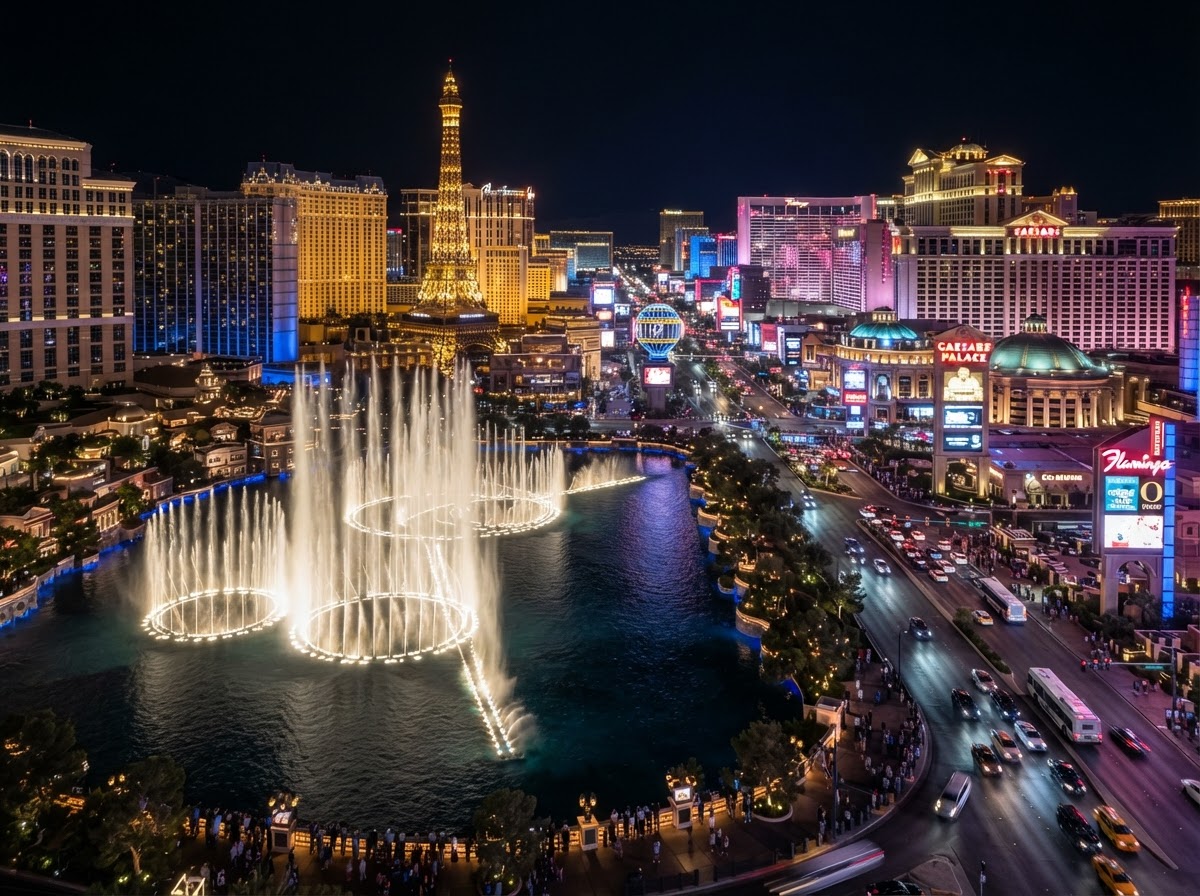
Las Vegas exists to entertain. The Strip, the 4-mile stretch of Las Vegas Boulevard, is a parade of mega-resorts, each with its own theme — the Bellagio fountains, the Venetian canals, the Paris Eiffel Tower, the Luxor pyramid, the New York skyline. The casinos run 24 hours, the shows are world-class (Cirque du Soleil, residencies, magic, comedy), the restaurants are by celebrity chefs, and the nightlife is legendary. Beyond the Strip, the city is the gateway to the Grand Canyon, the Hoover Dam, the Valley of Fire and Death Valley. Las Vegas is both the spectacle and the base for the desert.
The Strip and the mega-resorts
The Strip is the heart of Las Vegas. Walk it (or take the monorail or the Deuce bus) to see the spectacle. The Bellagio, with its fountain show (free, every 30 minutes) and its conservatory, is the classic. The Venetian, with its indoor canals and gondolas, is the most extravagant. The Cosmopolitan and the Aria are the modern, upscale resorts. The Luxor (the pyramid) and the Excalibur (the castle) are the themed resorts. The Strat, at the north end, has the observation tower and the rides. Each resort is a self-contained world of casino, restaurants, shops and shows. The Strip is best at night, when the neon is at its most intense.
The shows and the entertainment
Las Vegas is the show capital of the world. Cirque du Soleil has multiple resident shows (O at the Bellagio, Mystère at Treasure Island, KÀ at the MGM Grand). The residencies — the big-name musicians who play extended runs — are a Las Vegas institution. The magic shows (Penn & Teller, David Copperfield) are a classic. The comedy clubs and the celebrity-chef restaurants are part of the entertainment. The nightclubs (Omnia, Hakkasan, XS) are among the biggest in the world. Book the major shows in advance. Compare show and activity options across providers for the best prices.
Downtown and Fremont Street
Downtown Las Vegas, the original city, is a contrast to the Strip — older, cheaper and more authentic. Fremont Street, the original Strip, is now a pedestrian mall with a canopy of LED screens (the Viva Vision light show), the SlotZilla zip line and the classic casinos (the Golden Nugget, the Binion's, the Four Queens). The Neon Museum, the boneyard of old Las Vegas signs, is a unique and atmospheric visit, especially at night. The Arts District, south of downtown, has the breweries, the galleries and the vintage shops. Downtown is the Las Vegas of the Rat Pack era, and it is worth a visit.
The Grand Canyon and the desert
Las Vegas is the gateway to the Grand Canyon. The West Rim (the closest, about 2 hours) has the Skywalk, the glass bridge over the canyon, and is on the Hualapai reservation. The South Rim (the classic, about 4.5 hours or a 1-hour flight) is the most spectacular and the most visited. Helicopter and small-plane tours from Las Vegas are the premium option, with aerial views of the canyon and the Hoover Dam. The Hoover Dam, 45 minutes away, is an engineering marvel. The Valley of Fire State Park, 1 hour away, has red sandstone formations and petroglyphs. Death Valley, 2 hours away, is the lowest point in North America. Compare tour options across providers.
Where to stay
The Strip is the heart of the experience — the mega-resorts (the Bellagio, the Venetian, the Cosmopolitan, the Wynn) are the destination. Mid-Strip (the Bellagio, the Caesars, the Paris) is the most central. The south Strip (the Mandalay Bay, the Luxor, the Excalibur) is quieter. The north strip (the Wynn, the Strat) is further from the centre. Downtown is cheaper and more authentic. Compare hotel options across booking platforms to find the right balance of location, price and style for your trip, and note that Las Vegas hotel prices vary dramatically by day of the week and events.
When to visit Las Vegas
Las Vegas is a year-round destination, but the desert climate matters. The best times are spring (March-May) and autumn (September-November), when it is warm and pleasant (20-30°C). Summer (June-August) is very hot (40°C+), but the casinos, shows and restaurants are air-conditioned, and the pools are the main daytime activity. Winter (December-February) is mild (15-18°C) and the cheapest time, though it can be cold at night. Avoid the major events (CES in January, the Super Bowl, major fights) if you dislike crowds and high prices. Whenever you go, the indoor entertainment is climate-controlled.
Getting to Las Vegas
Harry Reid International Airport (LAS), formerly McCarran, is the main airport, remarkably close to the Strip — a 10-minute taxi. Compare flights across providers — Las Vegas is one of the busiest airports in the US with direct flights across the country and internationally. A pre-booked private transfer is the most convenient option if you have luggage or a group; compare transfer providers for fixed-price options. Taxis and ride-hailing apps are available. The airport's proximity to the Strip is one of the conveniences of Las Vegas. Build in minimal time for the transfer.
Getting around Las Vegas
The Strip is walkable, but it is long (4 miles), and the distances between resorts are deceptively large. The Las Vegas Monorail runs along the east side of the Strip. The Deuce bus runs along the Strip 24 hours. Taxis and ride-hailing apps (Uber, Lyft) are plentiful. For the Grand Canyon, the Hoover Dam and the desert, compare car rental options — driving is on wide, straight desert roads, and a car gives you the freedom to explore. The I-15 connects to Los Angeles (4 hours) and to the national parks. Within the city, the resorts are connected by walkways, monorail and trams.
Staying connected with an eSIM
The US has excellent mobile data. A travel eSIM is the easiest way to have it from the moment you land. Compare data-only eSIMs across providers, checking data allowances and validity. A single-country US plan is usually cheapest; a regional North America plan is better value if you are combining Las Vegas with a wider US or Mexico trip. Remember that most travel eSIMs are data-only, so keep your home line active for SMS verification codes.
Muslim-friendly travel in Las Vegas
Las Vegas has a growing Muslim community, and it is a reasonably Muslim-friendly city, though it requires some planning given the city's reputation. Halal food is available — a number of restaurants on the Strip and in the city offer halal options, and halal-finder apps are helpful. The Las Vegas Mosque (the Masjid al-Tawheed) and other mosques serve the community. Prayer facilities are available at the airport and in the mosques. Las Vegas is tolerant and welcoming, and the resorts are accustomed to international visitors of all faiths. With a little research, Las Vegas is a comfortable destination for Muslim travellers.
Protecting your trip
Travel insurance is recommended for the US — medical care is excellent but extremely expensive for visitors. Compare policies and check what is included, particularly medical coverage and coverage for adventure activities like helicopter tours. If your flight to or from Las Vegas is delayed, cancelled or overbooked, you may be entitled to compensation under US air passenger rights regulations; specialist services can check your eligibility and handle the claim with the airline on your behalf. Keep your boarding pass and booking reference until you are home.
Recommended Offers
Relevant offers for this trip. You'll be redirected to the partner to complete your booking.
Flights to Las Vegas
Check PriceTours & activities in Las Vegas
View DealsAttraction tickets in Las Vegas
View OfferExperiences & day tours in the USA
View DealsCity passes & multi-attraction tickets
View PassesSelf-guided audio walks in Las Vegas
View OfferLas Vegas airport private transfer
Check PriceAirport transfer with English-speaking driver
View AvailabilityCompare airport transfer prices
Check PriceShared & private airport transfers
View Offerthe USA eSIM data
View DealUnlimited the USA data eSIM
View DealFlexible global data eSIM
View DealPrepaid the USA data eSIM
View DealLuggage storage in Las Vegas
View DealCar rental comparison in the USA
Check PriceCar rental across the USA
Check PriceCar hire with price-drop protection
Check PriceCar hire with AutoEurope
Check PriceLocal car rental in the USA
Check PriceScooter & motorbike rental
Check PriceFlight delay compensation check
Check EligibilityFlight compensation claim service
Check EligibilitySome links may be affiliate links. JalanDeals may earn a commission when you book through selected partners.
Frequently Asked Questions
How many days do I need in Las Vegas?
Three to four days is a good first trip — enough for the Strip, a show, downtown and a Grand Canyon day trip. A week lets you add the national parks.
When is the best time to visit Las Vegas?
Spring (March-May) and autumn (September-November) are warm and pleasant. Summer is very hot (40°C+). Winter is mild and the cheapest time.
How do I get from Las Vegas airport to the Strip?
The airport is 10 minutes from the Strip. A pre-booked private transfer is easiest with luggage; taxis and ride-hailing apps are plentiful.
Is Las Vegas Muslim-friendly?
Reasonably so, with planning. Halal food is available on the Strip and in the city, mosques serve the community, and prayer rooms are at the airport. Use halal-finder apps.
Do I need a visa for the USA?
The US requires a visa or ESTA (for eligible countries) — check the official US immigration guidance for your passport before travel.
Which eSIM works in the USA?
Compare data-only eSIMs from Airalo, Yesim, Drimsim and Saily that cover the USA. A regional North America plan is good value if you are visiting multiple countries.
Explore more
Related destination hubs and deal categories for this trip.
Deal categories
Affiliate disclosure: This article contains affiliate links. JalanDeals may earn a commission when you book through selected partners, at no additional cost to you. Prices and availability are set by the provider.