
In this article
- 1. Why Peru is the cultural heart of South America
- 2. Lima — the food capital
- 3. Cusco and the Sacred Valley
- 4. Machu Picchu
- 5. The Amazon and the north
- 6. Where to stay
- 7. When to visit Peru
- 8. Getting to Peru
- 9. Getting around Peru
- 10. Staying connected with an eSIM
- 11. Muslim-friendly travel in Peru
- 12. Protecting your trip
Peru is the country of Machu Picchu, the lost city of the Incas, but it is also the country of Lima, the food capital of South America, and of Cusco, the ancient Inca capital, and of the Sacred Valley, the cloud forests and the Andes. It is a place of extraordinary variety — the desert coast, the Andes, the Amazon — and of extraordinary depth, with a history that predates the Incas by thousands of years. This guide covers what to see, where to stay, when to go, how to get around, how to stay connected and how to compare current offers from multiple travel brands before completing your booking with a partner.
Why Peru is the cultural heart of South America
Peru's appeal is its depth and its variety. The history, from the Norte Chico civilization (one of the oldest in the world) to the Incas to the colonial era, is one of the deepest in the Americas. The landscape, from the desert coast to the Andes to the Amazon, is one of the most varied. The food, the ceviche and the fusion cuisine, is the best in South America (Lima has more world-class restaurants than any city on the continent). The culture, the Inca and the pre-Inca, the colonial and the modern, is a living layering. It is also a practical destination, with good infrastructure for the main sights. Peru is the rewarding, varied introduction to South America.
Lima — the food capital
Lima, the capital, is the food capital of South America. The ceviche (the raw fish cured in lime), the lomo saltado (the stir-fried beef), the aji de gallina (the creamy chicken) and the anticuchos (the grilled skewers) are the classics. The world-class restaurants (Central, Maido, Kjolle, named among the best in the world) are the fine dining. The Miraflores district, on the cliff above the sea, is the upscale, visitor-friendly base, with the parks, the Malecon (the clifftop promenade) and the restaurants. The Barranco district is the bohemian, nightlife area. The historic centre (the Plaza Mayor, the cathedral, the convents) is the colonial heart. Lima is the first stop and the foodie destination.
Cusco and the Sacred Valley
Cusco, the ancient Inca capital at 3,400m, is the gateway to Machu Picchu and a destination in its own right — the Plaza de Armas, the cathedral, the Qorikancha (the Inca temple), the Sacsayhuaman fortress and the San Blas artisan quarter. Acclimatise to the altitude before hiking. The Sacred Valley (the Valle Sagrado), between Cusco and Machu Picchu, has the Inca ruins (Pisac, Ollantaytambo), the markets (Pisac, Chinchero), the salt pans of Maras and the agricultural terraces of Moray. The valley is at a lower altitude than Cusco, so it is a good place to acclimatise. Cusco and the Sacred Valley are the cultural and the scenic heart of the Inca world.
Machu Picchu
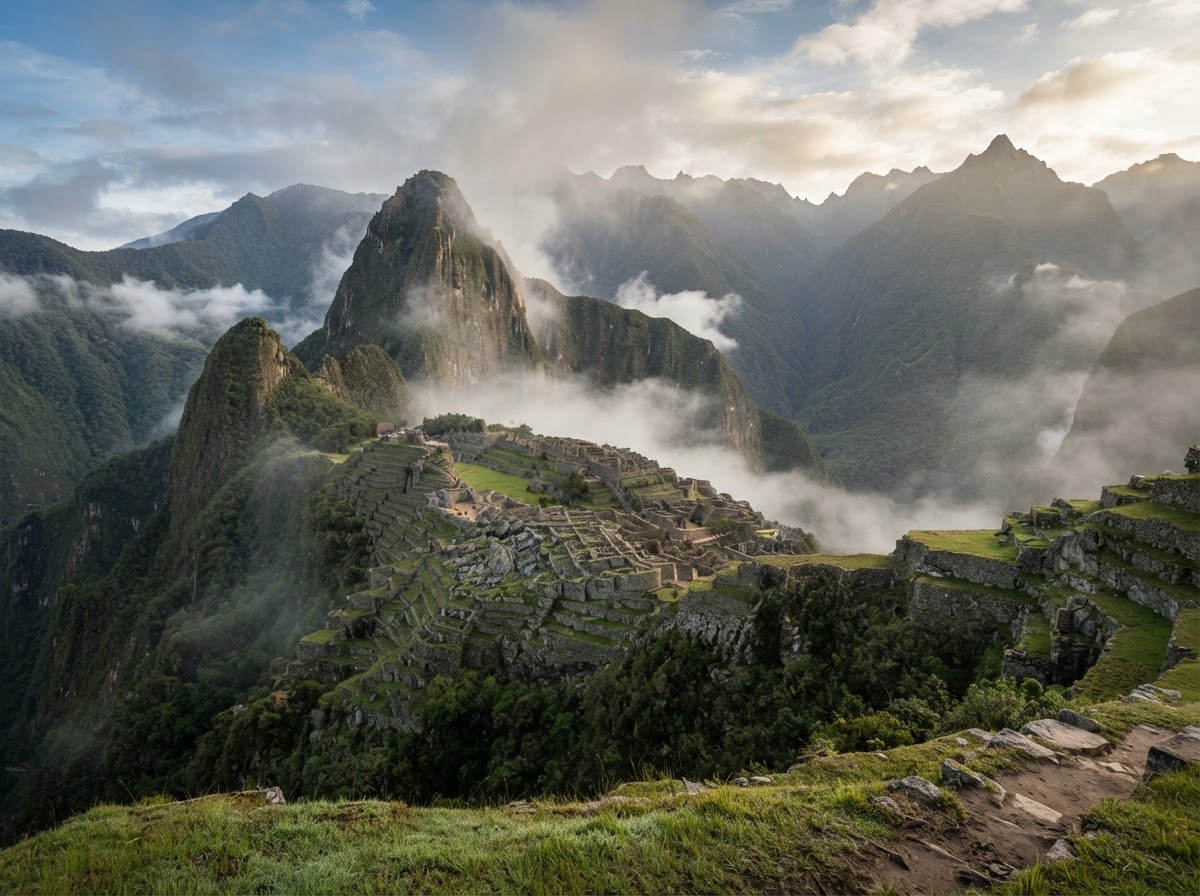
Machu Picchu, the 15th-century Inca citadel on a mountain saddle at 2,430m, is the icon of Peru and a new seven wonder of the world. The train from Cusco (or Ollantaytambo) to Aguas Calientes (Machu Picchu Pueblo), the bus up to the citadel, and the guided tour are the classic experience. The Inca Trail, the 4-day hike on the original Inca road, is the pilgrimage (book months in advance). The Huayna Picchu and the Machu Picchu Mountain hikes are the summit views (book in advance, limited permits). Go early or late to beat the crowds, and stay overnight in Aguas Calientes for the second morning. Machu Picchu is the highlight of any Peru trip, and it earns its fame.
The Amazon and the north
Beyond Machu Picchu, Peru has the Amazon — the Manu National Park (one of the most biodiverse places on earth), the Tambopata Reserve (the accessible rainforest near Puerto Maldonado) and the Pacaya-Samiria Reserve (the flooded forest near Iquitos). The north has Chan Chan (the largest adobe city in the world, near Trujillo), the Lord of Sipan tomb (the richest pre-Columbian tomb, near Chiclayo) and the beach town of Mancora. The south has Lake Titicaca (the highest navigable lake, with the floating Uros islands) and the Colca Canyon (one of the deepest, with the condors). Peru is a country that rewards the longer trip.
Where to stay
Lima (Miraflores for the upscale, Barranco for the bohemian, the centre for the colonial) is the first base. Cusco (the centre for the history, San Blas for the artisan) is the Inca base. The Sacred Valley (Ollantaytambo, Urubamba) is the acclimatisation and the lower-altitude base. Aguas Calientes is the Machu Picchu base. Compare hotel options across booking platforms to find the right balance of location, price and style for your trip, and note that the altitude matters — the Sacred Valley is lower than Cusco, so it is a good place to acclimatise before Cusco and Machu Picchu.
When to visit Peru
Peru has a varied climate. The best time for Machu Picchu and the Andes is the dry season, from May to September, when it is dry and sunny (but cold at night at altitude) — this is peak season. The wet season (December-March) is rainier but greener and less crowded. Lima is a desert city, with a grey, damp winter (May-November) and a sunny summer (December-April). The Amazon is warm and wet year-round, with a wetter season (November-March). Peru is a year-round destination, but the dry season is the most comfortable for the Andes. Book Machu Picchu and the Inca Trail well in advance for the dry season.
Getting to Peru
Jorge Chavez International Airport (LIM), in Lima, is the main international airport. Compare flights across providers — Lima is the main hub of South America's west coast, with direct flights across the Americas and Europe. A pre-booked private transfer is the most convenient option to Miraflores; compare transfer providers for fixed-price options. Taxis are available — agree the fare or use the app. For Cusco, a domestic flight (1 hour) from Lima is the way. For Machu Picchu, the train from Cusco (or Ollantaytambo) to Aguas Calientes is the classic. Build in time for the domestic connections and the train.
Getting around Peru
Peru's transport ranges from good highways to rough mountain roads. The domestic flights (LATAM, Sky, JetSmart) connect Lima to Cusco, Arequipa, Iquitos and the main cities. The buses (Cruz del Sur, Oltursa) are the comfortable, long-distance option. The trains (PeruRail, IncaRail) connect Cusco to Machu Picchu and to Lake Titicaca. For the Sacred Valley, the Colca Canyon and the freedom to explore, compare car rental options — driving is on the right, and the mountain roads require care. Within the cities, taxis and ride-hailing apps work. Peru is a place where the journeys are part of the experience.
Staying connected with an eSIM
Peru has decent mobile data in the cities and along the main routes, though coverage in the Andes, the Amazon and the remote areas can be patchy. A travel eSIM is the easiest way to have data from the moment you land. Compare data-only eSIMs across providers, checking coverage if you plan to travel beyond Lima and Cusco, data allowances and validity. A single-country Peru plan is usually cheapest; a regional South America plan is better value if you are combining Peru with neighbouring countries. Download offline maps for the Andes and the Amazon. Remember that most travel eSIMs are data-only, so keep your home line active for SMS verification codes.
Muslim-friendly travel in Peru
Peru has a small Muslim community, and it is a reasonably Muslim-friendly country, though it requires some planning. Halal food is limited but available — a few restaurants in Lima (the Miraflores area) and the main cities offer halal options, and halal-finder apps are helpful. The Asociacion Islamica del Peru and the mosques in Lima serve the community. Prayer facilities are limited outside the capital, so plan ahead. Peru is tolerant and welcoming, and the food culture, with its seafood (the ceviche) and its vegetarian options, offers some halal-adjacent choices. With a little research, Peru is a comfortable destination for Muslim travellers, though the halal options are fewer than in larger Muslim communities.
Protecting your trip
Travel insurance is recommended for Peru — medical care is good in Lima but limited at altitude and in the Amazon, and the altitude (Cusco at 3,400m) can cause altitude sickness. Compare policies and check what is included, particularly coverage for medical evacuation and adventure activities like the Inca Trail. If your flight to or from Peru is delayed, cancelled or overbooked, you may be entitled to compensation under applicable air passenger rights regulations; specialist services can check your eligibility and handle the claim with the airline on your behalf. Keep your boarding pass and booking reference until you are home.
Recommended Offers
Relevant offers for this trip. You'll be redirected to the partner to complete your booking.
Flights to Lima
Check PriceTours & activities in Lima
View DealsAttraction tickets in Lima
View OfferExperiences & day tours in Peru
View DealsCity passes & multi-attraction tickets
View PassesSelf-guided audio walks in Lima
View OfferLima airport private transfer
Check PriceAirport transfer with English-speaking driver
View AvailabilityCompare airport transfer prices
Check PriceShared & private airport transfers
View OfferPeru eSIM data
View DealUnlimited Peru data eSIM
View DealFlexible global data eSIM
View DealPrepaid Peru data eSIM
View DealLuggage storage in Lima
View DealCar rental comparison in Peru
Check PriceCar rental across Peru
Check PriceCar hire with price-drop protection
Check PriceCar hire with AutoEurope
Check PriceLocal car rental in Peru
Check PriceScooter & motorbike rental
Check PriceFlight delay compensation check
Check EligibilityFlight compensation claim service
Check EligibilitySome links may be affiliate links. JalanDeals may earn a commission when you book through selected partners.
Frequently Asked Questions
How many days do I need in Peru?
Ten days to two weeks is a good first trip — enough for Lima, Cusco, the Sacred Valley and Machu Picchu. Three weeks lets you add the Amazon and Lake Titicaca.
When is the best time to visit Peru?
May to September is the dry season for the Andes and Machu Picchu (peak). December to March is the wet season — greener but rainier. Lima is sunny in summer (December-April).
How do I get to Machu Picchu?
Fly Lima to Cusco (1 hour), then the train from Cusco or Ollantaytambo to Aguas Calientes, then the bus up to the citadel. The Inca Trail is the 4-day hike (book months in advance).
Is Peru Muslim-friendly?
Reasonably so, with planning. Halal food is limited but available in Lima (Miraflores), the main mosque is in Lima, and the country is tolerant. Use halal-finder apps.
Do I need a visa for Peru?
Peru offers visa-free entry to many nationalities for stays up to 183 days — check the official Peruvian immigration guidance for your passport before travel.
Which eSIM works in Peru?
Compare data-only eSIMs from Airalo, Yesim, Drimsim and Saily that cover Peru. Coverage in the Andes and the Amazon can be patchy, so download offline maps.
Explore more
Related destination hubs and deal categories for this trip.
Deal categories
Affiliate disclosure: This article contains affiliate links. JalanDeals may earn a commission when you book through selected partners, at no additional cost to you. Prices and availability are set by the provider.