
In this article
- 1. Why London is endlessly rewarding
- 2. The free museums
- 3. The Tower, Westminster and the Thames
- 4. The markets and the food
- 5. The neighbourhoods
- 6. Where to stay
- 7. When to visit London
- 8. Getting to London
- 9. Getting around London
- 10. Staying connected with an eSIM
- 11. Muslim-friendly travel in London
- 12. Protecting your trip
- 13. Beyond London
London is one of the world's great cities — a place where 2,000 years of history, a global culture and a restless energy combine into something genuinely unique. It has more free world-class museums than almost anywhere, the best theatre scene outside Broadway, markets that draw from every cuisine on earth, and a patchwork of distinct neighbourhoods each with its own character. It is big and spread out, but its public transport makes it easy to navigate, and its parks make it liveable. This guide covers what to see, where to stay, when to go, how to get around, how to stay connected and how to compare current offers from multiple travel brands before completing your booking with a partner.
Why London is endlessly rewarding
London's strength is its depth. It has been a major city for nearly two millennia, a global capital for centuries, and a magnet for people from every country — and all of that shows. You can walk from a Roman wall to a medieval tower, through a Victorian market, past a modern skyscraper, in 20 minutes. The museums are world-class and mostly free. The food, once mocked, is now among the best and most varied in the world. The theatre, music and pub culture are institutions. It is a city that rewards repeat visits — there is always another neighbourhood, another museum, another pub to discover.
The free museums
London's great national museums are free to enter, which is remarkable given their quality. The British Museum holds the Rosetta Stone, the Parthenon sculptures and 8 million other objects — focus on a few galleries rather than trying to see it all. The National Gallery in Trafalgar Square has one of the world's great collections of Western painting. The Tate Modern, in a converted power station, is the modern art museum. The Natural History Museum, the Science Museum and the Victoria and Albert Museum cluster in South Kensington. The Tate Britain holds British art. All are free (special exhibitions charge) and all are world-class. Plan your days around a museum or two — they are large.
The Tower, Westminster and the Thames
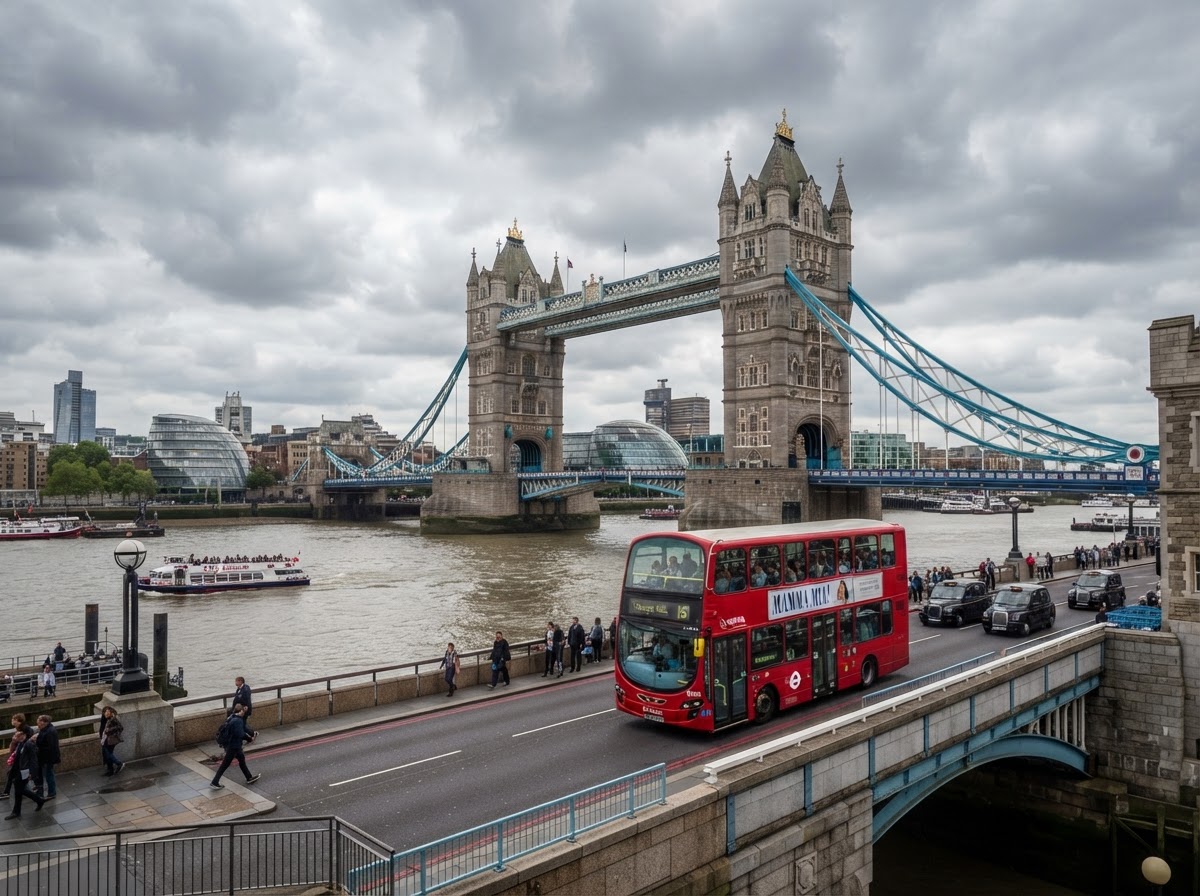
The Tower of London, founded in 1066, is a castle, a palace, a prison and the home of the Crown Jewels — book a tour with a Yeoman Warder (Beefeater) for the full story. Tower Bridge beside it is the iconic Victorian bridge. Westminster, the political heart, holds the Houses of Parliament, Big Ben and Westminster Abbey, where monarchs are crowned and buried. The London Eye across the river offers a panoramic view. The Thames is the spine of the city — walk its South Bank from Westminster to Tower Bridge for the best riverside stroll, passing the Tate Modern, Shakespeare's Globe and Borough Market. A Thames Clipper boat is a fast, scenic way to travel along the river.
The markets and the food
London's markets are among its great pleasures. Borough Market is the food market, with produce, street food and artisan stalls — go at lunchtime and eat. Camden Market is the alternative, fashion and street-food market by the canal. Portobello Road in Notting Hill is the antiques market on Saturdays. Brick Lane is the curry and vintage market in the East End. Maltby Street and Spa Terminus are the foodie's quieter alternatives to Borough. The food scene itself is now world-class: from the pub classics (fish and chips, pie, roast) to every cuisine on earth, especially in the East End, Soho and Brixton. Afternoon tea is a London institution — try a hotel or a more modern take. Muslim travellers will find halal options everywhere, especially in the East End, Whitechapel and Brixton — halal-finder apps help.
The neighbourhoods
London is a city of villages, and exploring them is the real pleasure. Soho and Covent Garden are the theatre and dining heart of the West End. Mayfair and Marylebone are elegant. Shoreditch and Hoxton are the trendy East End, full of street art, bars and startups. Notting Hill is the pastel-coloured, posh west. Brixton is the Caribbean, music and food south. Greenwich, downriver, is a village with the Meridian, the Cutty Sark and a great market. Camden is the alternative north. Each has its own pubs, markets and character — pick a few to explore properly rather than ticking them all off.
Where to stay
London is huge, so where you stay matters. The West End (Soho, Covent Garden, Bloomsbury) is central for first-time visitors but expensive. South Kensington and Westminster are elegant and central. The City and the East End (Shoreditch, Whitechapel) are trendy and well-connected. Greenwich and areas along the river are pleasant and slightly further out. Compare hotel options across booking platforms to find the right balance of location, price and style for your trip, and note that staying near a Tube station makes a big difference — London's transport is the key to the city.
When to visit London
London is a year-round destination. Summer (June-August) is the warmest and most popular, with long days and outdoor events, but also the most crowded and expensive. Spring (April-May) and autumn (September-October) are pleasant and quieter. Winter (November-February) is cold and dark but the museums, pubs and theatre are cosy, the Christmas lights and markets are wonderful, and the queues are short. London's weather is famously changeable — pack layers and a waterproof, and never trust a sunny morning. Avoid the school holidays if you want lower prices and fewer crowds.
Getting to London
London has six airports, but the main ones are Heathrow (LHR), the major international hub, and Gatwick (LGW), with Stansted, Luton and City for more European and domestic flights. Compare flights across providers — London is one of the best-connected cities in the world. Heathrow and Gatwick connect to the city by express train (the Elizabeth Line and Gatwick Express) and the Tube. A pre-booked private transfer is the most convenient option if you have luggage or a group; compare transfer providers for fixed-price meet-and-greet services. The Eurostar train connects London directly to Paris, Brussels and Amsterdam.
Getting around London
London has one of the best public transport systems in the world. The Tube (Underground) is fast, extensive and the default way to get around — tap a contactless bank card or an Oyster card. Buses are iconic (and the red double-deckers are great for sightseeing) and cover the gaps. The Overground and the new Elizabeth Line extend the network. Taxis (black cabs) are famous and knowledgeable; ride-hailing apps work well. Walking is the best way to see the central areas. Driving is not recommended — the congestion charge, the ULEZ and the traffic make it expensive and slow. For trips outside London, the train is the way to go.
Staying connected with an eSIM
The UK has fast, reliable mobile data, and a travel eSIM is the easiest way to have it from the moment you land. Compare data-only eSIMs across providers, checking data allowances and validity. A single-country UK plan is usually cheapest; a regional Europe plan is better value if you are combining London with European countries. Note that the UK left the EU, so EU roaming rules no longer apply — check your home SIM's roaming charges. Remember that most travel eSIMs are data-only, so keep your home line active for SMS verification codes.
Muslim-friendly travel in London
London is one of the most Muslim-friendly cities in Europe. It has a large Muslim population, and halal food is widely available — from halal pub classics to the curry houses of Brick Lane, the Turkish restaurants of Dalston and the Middle Eastern cafes of Edgware Road. The East End (Whitechapel, Tower Hamlets) is the heart of the Muslim community. Mosques are plentiful, including the East London Mosque and the London Central Mosque in Regent's Park. Prayer facilities are available at airports and in many large stores. Halal-finder apps are very helpful. London is diverse and liberal, so no special considerations are needed beyond standard respect at religious sites.
Protecting your trip
Travel insurance is recommended for the UK — medical care is free for residents via the NHS but chargeable for visitors; EU residents may be covered by the EHIC for emergencies. Compare policies and check what is included. If your flight to or from London is delayed, cancelled or overbooked, you are entitled to compensation under UK261 regulations (the post-Brexit equivalent of EU261); specialist services can check your eligibility and handle the claim with the airline on your behalf. Keep your boarding pass and booking reference until you are home.
Beyond London
London is a great base for the rest of the UK. Windsor Castle, Oxford, Cambridge, Bath and Stonehenge are all day trips by train or tour. The Cotswolds, the Lake District, Edinburgh and Cornwall are longer trips. The UK's train network connects the main cities, and a car is best for the countryside. Compare flights, trains, transfers and hotels across providers to build the route that works for your dates and budget.
Recommended Offers
Relevant offers for this trip. You'll be redirected to the partner to complete your booking.
Flights to London
Check PriceTours & activities in London
View DealsAttraction tickets in London
View OfferExperiences & day tours in the UK
View DealsCity passes & multi-attraction tickets
View PassesSelf-guided audio walks in London
View OfferLondon airport private transfer
Check PriceAirport transfer with English-speaking driver
View AvailabilityCompare airport transfer prices
Check PriceShared & private airport transfers
View Offerthe UK eSIM data
View DealUnlimited the UK data eSIM
View DealFlexible global data eSIM
View DealPrepaid the UK data eSIM
View DealLuggage storage in London
View DealCar rental comparison in the UK
Check PriceCar rental across the UK
Check PriceCar hire with price-drop protection
Check PriceCar hire with AutoEurope
Check PriceLocal car rental in the UK
Check PriceScooter & motorbike rental
Check PriceFlight delay compensation check
Check EligibilityFlight compensation claim service
Check EligibilitySome links may be affiliate links. JalanDeals may earn a commission when you book through selected partners.
Frequently Asked Questions
How many days do I need in London?
Four to five days is a good first trip — enough for the main museums, the Tower, Westminster and a few neighbourhoods. A week lets you add day trips.
When is the best time to visit London?
Summer (June-August) is warmest and most popular. Spring and autumn are pleasant and quieter. Winter is cold but cosy with Christmas lights and short queues. Pack layers and a waterproof.
How do I get from London airport to the city?
Heathrow and Gatwick connect by express train and the Tube. A pre-booked private transfer is easiest with luggage. Check which of London's six airports you arrive at.
Is London Muslim-friendly?
Very. Halal food is widely available (East End, Brick Lane, Edgware Road), mosques are plentiful, and prayer facilities are at airports and large stores. Halal-finder apps help.
Do I need a visa for the UK?
The UK requires a visa for some nationalities and is visa-free for many for stays up to six months — check the official UK government guidance for your passport before travel.
Which eSIM works in the UK?
Compare data-only eSIMs from Airalo, Yesim, Drimsim and Saily that cover the UK. A single-country plan is cheapest; note the UK left the EU so EU roaming rules no longer apply.
Explore more
Related destination hubs and deal categories for this trip.
Affiliate disclosure: This article contains affiliate links. JalanDeals may earn a commission when you book through selected partners, at no additional cost to you. Prices and availability are set by the provider.