
In this article
- 1. Understanding Manila
- 2. Intramuros — the walled city
- 3. Rizal Park and the bay
- 4. The food — a blend of cultures
- 5. Makati and Bonifacio Global City
- 6. Day trips from Manila
- 7. When to visit Manila
- 8. Getting to Manila
- 9. Getting around Manila
- 10. Staying connected with an eSIM
- 11. Muslim-friendly travel in Manila
- 12. Protecting your trip
Manila is the bustling, warm-hearted gateway to the Philippines — a megacity of more than 13 million people that most travellers pass through on their way to the country's famous beaches and islands, but which rewards those who pause. It is a city of contrasts: Spanish colonial walls beside American-style malls, gritty street life beside five-star hotels, and a food scene that blends Malay, Chinese, Spanish and American influences into something uniquely Filipino. This guide covers what to see, where to stay, when to go, how to get around, how to stay connected and how to compare current offers from multiple travel brands before completing your booking with a partner.
Understanding Manila
Manila is really Metro Manila — a constellation of 16 cities that have grown together into one vast conurbation. The City of Manila itself is the historic core, but business and modern life centre on Makati, Bonifacio Global City (BGC) and Ortigas. The city is hot, busy and traffic-clogged, but it is also friendly, English-speaking (the Philippines is one of the largest English-speaking countries in Asia) and full of energy. Approach it as a gateway with a day or two of its own rewards, and you will get the most from it.
Intramuros — the walled city
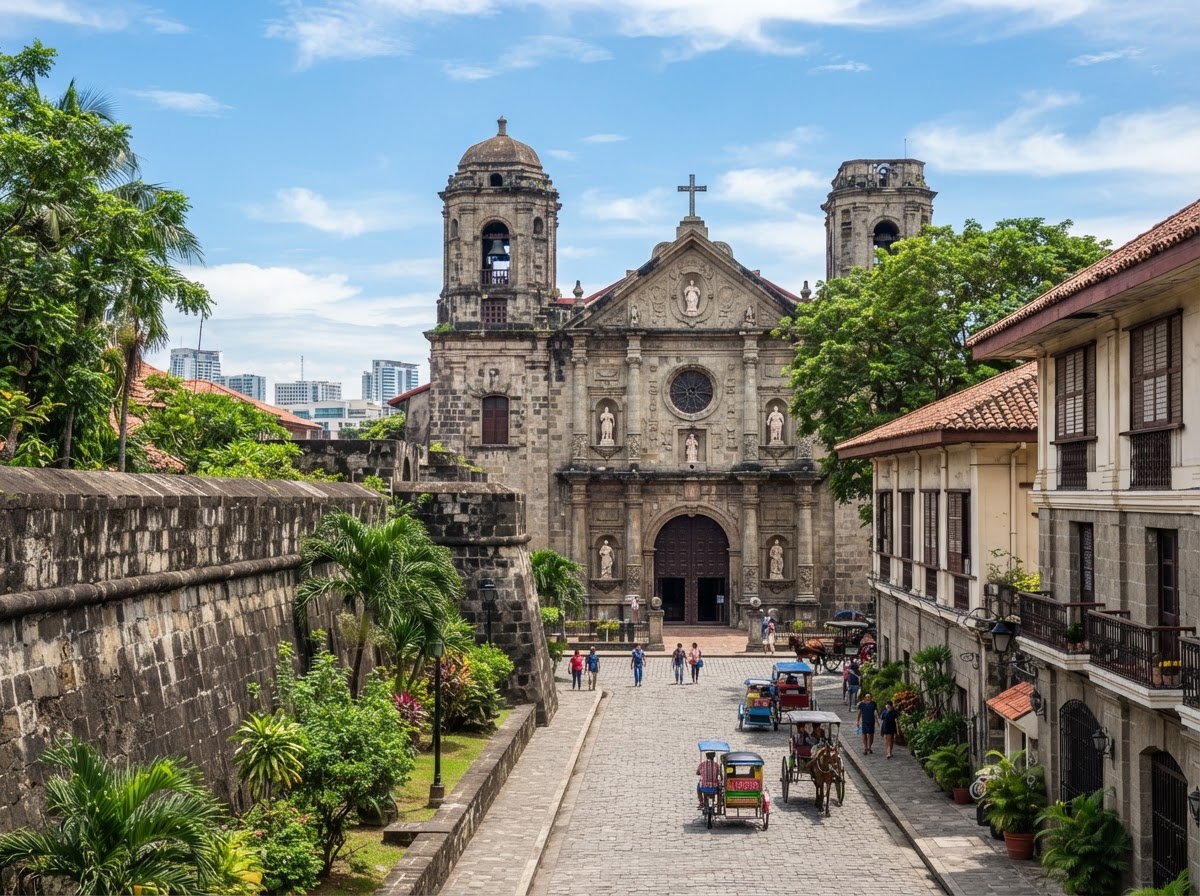
Intramuros (literally 'within the walls') is the Spanish-era walled city and the historic heart of Manila. Its thick stone walls, built from the late 16th century, enclose churches, plazas and colonial buildings. The highlight is San Agustin Church, a UNESCO-listed baroque church and the oldest stone church in the Philippines, with a beautiful museum and an ornate ceiling. Nearby, Manila Cathedral has been rebuilt several times and dominates the central plaza. Fort Santiago, the Spanish fortress where the national hero Jose Rizal was imprisoned before his execution, is a moving and well-presented site. Walk the walls at dusk for the best light and cooler air.
Rizal Park and the bay
Rizal Park (Luneta) is the large national park beside Manila Bay, where Rizal was executed and is now commemorated. It is the city's gathering place — families, joggers and the famous Manila Bay sunset, which paints the sky over the bay every evening. The park also holds the National Museum complex, which has been significantly renovated and is well worth a visit for Philippine art and history. The nearby Quirino Grandstand and the Ocean Park aquarium are family options. The bay sunset is one of the most reliable and beautiful in Asia — arrive early to get a spot on the seawall.
The food — a blend of cultures
Filipino food is having its moment, and Manila is the place to understand it. The influences are Malay, Chinese, Spanish and American, and the result is hearty, sweet and savoury. Adobo (meat braised in vinegar, soy and garlic) is the unofficial national dish. Sinigang is a sour tamarind soup. Lechon (whole roast pig) is the celebration dish — try it at a Cebu-style lechon restaurant. Halo-halo is the iconic shaved-ice dessert with beans, jellies and ube (purple yam). For the full experience, try a buffet at a heritage restaurant like Barbara's in Intramuros, or the modern Filipino tasting menus at restaurants in BGC. Street food — kwek-kwek, fish balls, isaw — is best tried at a busy, high-turnover stall.
Makati and Bonifacio Global City
Makati is the financial district — skyscrapers, upscale malls (Greenbelt, Glorietta), hotels and a lively nightlife scene in Poblacion, where bars and restaurants spill onto the streets. Bonifacio Global City (BGC) is the newer, planned district — clean, walkable, full of high-rise apartments, street art, cafes and the huge High Street and SM Aura malls. Both areas are where most business travellers and many tourists stay, and they offer the most comfortable base for a Manila stopover. They are also where you find the city's best international dining and rooftop bars.
Day trips from Manila
Manila is the jumping-off point for some of the Philippines' most famous destinations. Tagaytay, about 1.5 hours south, overlooks Taal Volcano — a volcano within a lake within a volcano — and offers cooler air and good restaurants. Corregidor, the WWII island fortress in Manila Bay, is a fascinating day trip by ferry. For beaches, most travellers fly on — Palawan (El Nido, Coron) and Boracay are the headline island destinations, reached by short domestic flights. Compare flights, transfers and tours across providers to build the route that works for your dates and budget, and book domestic flights in advance as they sell out in peak season.
When to visit Manila
Manila is hot and humid year-round, with temperatures around 30°C. The dry season runs from December to May, with March to May the hottest months. The wet season runs from June to November, with July to September the wettest — typhoons can hit during this period, causing flooding. The best time to visit is the dry, cooler months of December to February. Avoid Holy Week (the week before Easter) if you want full transport and services, as much of the country shuts down. Christmas in the Philippines is famously long and festive — the season starts in September — and is a wonderful but busy time to visit.
Getting to Manila
Ninoy Aquino International Airport (MNL) is the main gateway, with four terminals — check which terminal your airline uses, as transfers between them can be slow. Compare flights across providers; Manila is well connected across Asia, the Middle East and North America. A pre-booked private transfer is the most reliable way into the city, especially with luggage, as airport taxis can be variable; compare transfer providers for fixed-price meet-and-greet services. Ride-hailing apps work but pickup at the airport can be chaotic. Build in extra time for traffic — Manila's congestion is legendary.
Getting around Manila
Traffic is the defining challenge of getting around Manila. The metro rail system (LRT, MRT) is the fastest way to move along its lines, but coverage is limited and trains are crowded at rush hour. Ride-hailing apps (Grab) are the practical choice for most visitors — book a car to avoid the heat and the traffic. The jeepney, the colourful extended jeep that is the icon of Philippine transport, is cheap and authentic but requires local knowledge of routes. For day trips, a private driver or a booked tour is the simplest option. Driving yourself is not recommended for visitors due to the traffic and the driving style.
Staying connected with an eSIM
The Philippines has good, affordable mobile data, and a travel eSIM is the easiest way to have it from the moment you land. Compare data-only eSIMs across providers, checking coverage if you plan to travel beyond Manila to the islands (where signal can vary), data allowances and validity. A single-country Philippines plan is usually cheapest; a regional Southeast Asia plan is better value if you are combining the Philippines with neighbouring countries. Remember that most travel eSIMs are data-only, so keep your home line active for SMS verification codes, and download offline maps for the islands.
Muslim-friendly travel in Manila
The Philippines is a Christian-majority country, but Manila has a significant Muslim community and Muslim-friendly options are available with a little planning. The Quiapo district has a large Muslim community and halal restaurants, particularly along the streets around the Golden Mosque. Many Middle Eastern and Indonesian/Malaysian restaurants in Makati and BGC are halal. Halal-finder apps are helpful. Prayer facilities are available at the airport and in some malls. The southern Philippines (Mindanao) is Muslim-majority, but for Manila itself, a little research makes for a comfortable visit. An eSIM helps you locate halal restaurants and mosques on the go.
Protecting your trip
Travel insurance is recommended for the Philippines — medical care at private hospitals is good but can be expensive, and typhoons can disrupt travel. Compare policies and check what is included, particularly coverage for any island-hopping or adventure activities. If your flight to or from Manila is delayed, cancelled or overbooked, you may be entitled to compensation under applicable air passenger rights regulations; specialist services can check your eligibility and handle the claim with the airline on your behalf. Keep your boarding pass and booking reference until you are home.
Recommended Offers
Relevant offers for this trip. You'll be redirected to the partner to complete your booking.
Flights to Manila
Check PriceTours & activities in Manila
View DealsAttraction tickets in Manila
View OfferExperiences & day tours in Philippines
View DealsCity passes & multi-attraction tickets
View PassesSelf-guided audio walks in Manila
View OfferManila airport private transfer
Check PriceAirport transfer with English-speaking driver
View AvailabilityCompare airport transfer prices
Check PriceShared & private airport transfers
View OfferPhilippines eSIM data
View DealUnlimited Philippines data eSIM
View DealFlexible global data eSIM
View DealPrepaid Philippines data eSIM
View DealLuggage storage in Manila
View DealCar rental comparison in Philippines
Check PriceCar rental across Philippines
Check PriceCar hire with price-drop protection
Check PriceCar hire with AutoEurope
Check PriceLocal car rental in Philippines
Check PriceScooter & motorbike rental
Check PriceFlight delay compensation check
Check EligibilityFlight compensation claim service
Check EligibilitySome links may be affiliate links. JalanDeals may earn a commission when you book through selected partners.
Frequently Asked Questions
How many days do I need in Manila?
One to two days is enough for Intramuros, Rizal Park and the best food. Most travellers use Manila as a gateway to the islands and add a day or two here.
When is the best time to visit Manila?
December to February is the coolest, driest time. March to May is hot and dry; June to November is wet with possible typhoons. Avoid Holy Week if you need full transport.
How do I get from Manila airport to the city?
A pre-booked private transfer is the most reliable option. Ride-hailing apps work but airport pickup can be chaotic. Build in extra time for traffic.
Do I need a visa for the Philippines?
The Philippines offers visa-free entry to many nationalities for stays up to 30 days — check the official Philippine immigration guidance for your passport before travel.
Is Manila Muslim-friendly?
With planning, yes. The Quiapo district has halal restaurants and the Golden Mosque, and many Middle Eastern restaurants in Makati and BGC are halal. Halal-finder apps help.
Which eSIM works in the Philippines?
Compare data-only eSIMs from Airalo, Yesim, Drimsim and Saily that cover the Philippines. Coverage on the islands can vary, so download offline maps.
Explore more
Related destination hubs and deal categories for this trip.
Deal categories
Affiliate disclosure: This article contains affiliate links. JalanDeals may earn a commission when you book through selected partners, at no additional cost to you. Prices and availability are set by the provider.