
In this article
- 1. Why Marrakech is intoxicating
- 2. Jemaa el-Fnaa — the heart of the city
- 3. The souks and the medina
- 4. The palaces, gardens and museums
- 5. The riads — staying in the medina
- 6. The Atlas Mountains and the desert
- 7. The food — tagines, couscous and mint tea
- 8. When to visit Marrakech
- 9. Getting to Marrakech
- 10. Getting around Marrakech
- 11. Staying connected with an eSIM
- 12. Muslim-friendly travel in Marrakech
- 13. Protecting your trip
- 14. Beyond Marrakech
Marrakech is a city that floods the senses — the call to prayer echoing over terracotta rooftops, the spice-and-leather scent of the souks, the snake charmers and storytellers of Jemaa el-Fnaa, the cool tiled courtyards of the riads hidden behind unassuming doors. It is the great city of the Moroccan south, founded nearly 1,000 years ago, and it remains a place where the medieval and the modern sit side by side. Beyond the city walls rise the snow-dusted Atlas Mountains, and beyond them the Sahara. This guide covers what to see, where to stay, when to go, how to get around, how to stay connected and how to compare current offers from multiple travel brands before completing your booking with a partner.
Why Marrakech is intoxicating
Marrakech works on you. It is not a city of single great monuments but of atmosphere — the pink walls, the palm-lined avenues, the maze of the medina, the sudden quiet of a riad courtyard after the noise of the souk. It is a city to get lost in, literally — the medina has no grid and no signs, and wandering is the point. The culture is Berber, Arab and French, the food is fragrant, and the hospitality is genuine. It is close to Europe (a short flight) yet feels deeply different, which is its enduring appeal.
Jemaa el-Fnaa — the heart of the city
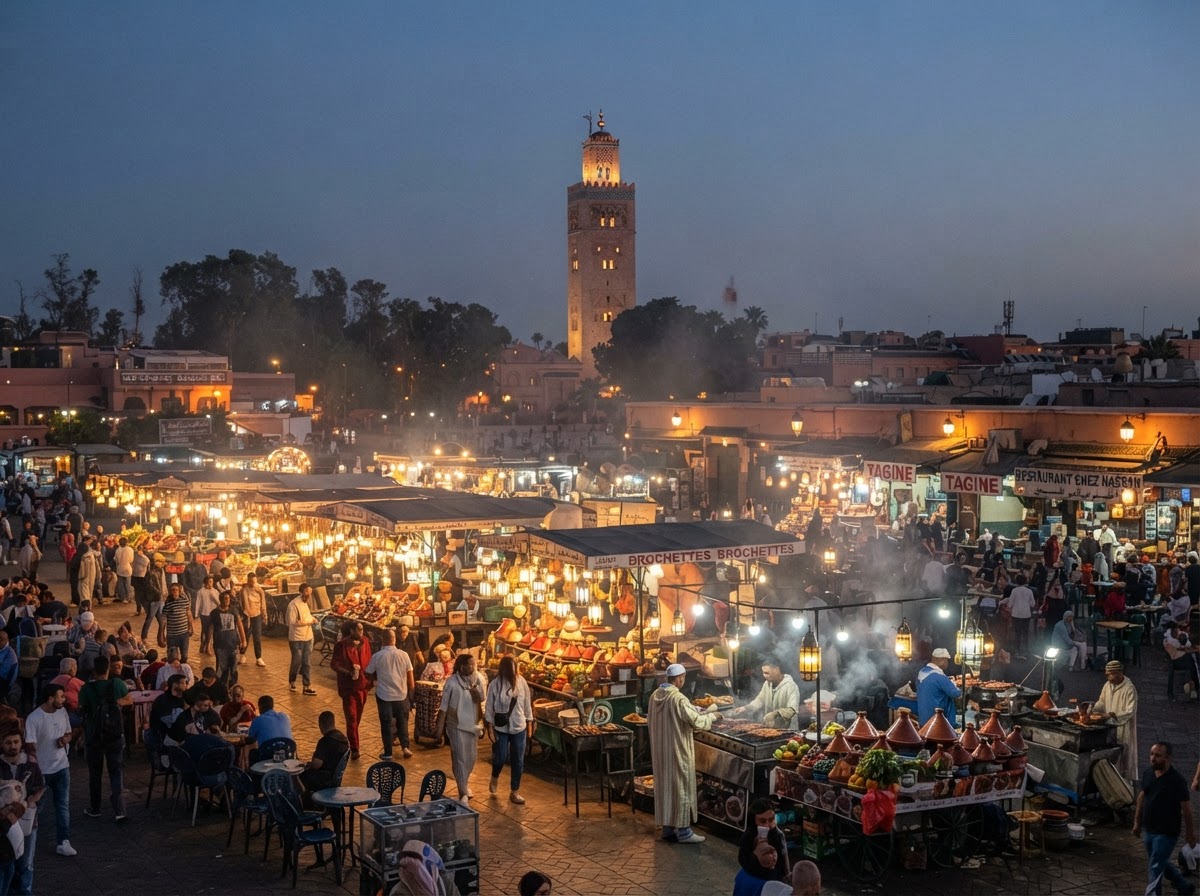
Jemaa el-Fnaa is the great square at the centre of Marrakech and a UNESCO-recognised 'masterpiece of oral heritage'. By day it is a market of orange-juice sellers, dried-fruit stalls and snake charmers; by night it transforms into a vast open-air food market and theatre, with storytellers, musicians, henna artists and dozens of food stalls cooking tagines, grilled meats and snail soup. It is at its best after dark, when the locals come out and the atmosphere is electric. Eat at a busy stall (follow the crowds), drink the fresh orange juice, and take it all in. The Koutoubia Mosque, the city's landmark minaret, towers over the square.
The souks and the medina
The souks of Marrakech are a vast maze of covered alleys organised by trade — the dyers' souk, the leather souk, the metalworkers, the spice souk, the carpet souk. It is one of the great shopping experiences in the world, but it requires patience and bargaining. Start at around a third of the asking price and meet in the middle; never show too much interest; and be willing to walk away. Buy carpets, leather, lanterns, ceramics, spices and argan oil. The medina around the souks is a living city of houses, mosques and small squares — get lost in it (you will always find your way back to a main street). The Ben Youssef Madrasa, a stunning former Quranic school, is a highlight. A guide for the souks is worth it for the first visit.
The palaces, gardens and museums
Marrakech has several beautiful historic buildings. The Bahia Palace is a 19th-century palace of tiled courtyards and carved ceilings. The Saadian Tombs, rediscovered in 1917, are a beautiful royal necropolis. The Ben Youssef Madrasa is a masterpiece of Moroccan tilework and carving. The Majorelle Garden, restored by Yves Saint Laurent, is a cool, blue-and-yellow garden of cacti and bamboo — a wonderful escape from the heat. The adjacent YSL Museum celebrates the designer. The Marrakech Museum, in a former palace, holds art and a stunning courtyard. Each is a short walk or a short taxi ride from the square.
The riads — staying in the medina
Staying in a riad — a traditional courtyard house converted to a guesthouse — is the classic Marrakech experience. Behind an unassuming door in a narrow medina lane is a tiled courtyard with a pool or garden, a few rooms and a rooftop terrace. It is quiet, intimate and atmospheric, and the hosts are usually excellent. There are hundreds, from budget to luxury. The new town (Gueliz) has conventional international hotels if you prefer. Compare hotel and riad options across booking platforms to find the right balance of location, price and style for your trip, and note that riads in the medina are reached on foot through the lanes, so pack light if you can.
The Atlas Mountains and the desert
Beyond Marrakech, the Atlas Mountains rise — snow-capped in winter, terraced with Berber villages, and within an hour's drive. A day trip to the Ourika Valley, with its waterfalls and Berber villages, is the easiest escape. The Toubkal National Park offers trekking up North Africa's highest peak. Further afield, the desert — the dunes of Erg Chebbi near Merzouga or the quieter Erg Chigaga — is a 2-day trip for the classic Sahara camel-trek and overnight camp experience. Book through a reputable operator — compare tour options across providers — and check what is included. The mountains and desert are best in the cooler months; in summer they are extremely hot.
The food — tagines, couscous and mint tea
Moroccan food is one of the great cuisines, fragrant with spices and slow-cooked. The tagine — a conical clay pot and the stew cooked in it — is the everyday dish, with chicken, lamb or vegetables with preserved lemon, olives or prunes. Couscous is the Friday family dish. Pastilla (b'stilla) is a sweet-savoury pie of pigeon, almonds and cinnamon. Harira is the lentil-and-tomato soup of Ramadan. Street food includes msemen (flaky flatbread), grilled corn and macaron. Mint tea is the national drink, poured from a height and very sweet — it is a symbol of hospitality and is offered everywhere. Moroccan food is overwhelmingly halal, given the Muslim majority.
When to visit Marrakech
The best times are spring (March to May) and autumn (September to November), when the weather is warm and pleasant (25-28°C) and the light is beautiful. Winter (December-February) is cool, especially at night, and the Atlas can have snow, but the city is comfortable. Summer (June-August) is very hot (40°C+), making the medina exhausting in the middle of the day — early mornings and evenings are the only comfortable times. Avoid the major Moroccan holidays and the Eid periods if you dislike crowds. Ramadan (dates vary) affects daytime dining, though tourist riads and restaurants continue to serve, and the iftar experience is wonderful. Whenever you go, bring layers — the desert climate means hot days and cool nights.
Getting to Marrakech
Marrakech Menara Airport (RAK) is close to the city and is well connected across Europe, with many low-cost and charter flights. Compare flights across providers. The airport is a short drive from the medina. A pre-booked private transfer is the most convenient option, especially with luggage and to find your riad in the medina lanes; compare transfer providers for fixed-price meet-and-greet services. Taxis are available but agree the fare in advance. The high-speed Al Boraq train connects Tangier to Casablanca, with a connecting service to Marrakech. Build in time for the medina walk to your riad.
Getting around Marrakech
The medina is walked — there are no cars in most of it, only motorbikes, bicycles and pedestrians. The new town (Gueliz) and the modern areas are served by taxis (agree the fare or use the meter) and a few bus lines. Ride-hailing apps have limited coverage. For day trips to the mountains or the coast, a private driver or a booked tour is the simplest option. Compare car rental options if you want to explore the wider region independently, though driving in the medina is impossible and the city traffic is busy. For the desert, you need a 4x4 with a guide — book a tour.
Staying connected with an eSIM
Morocco has decent mobile data in the cities and along the main highways, but coverage in the mountains and the desert can be patchy. A travel eSIM is the easiest way to have data from the moment you land. Compare data-only eSIMs across providers, checking coverage in the areas you plan to visit, data allowances and validity. A single-country Morocco plan is usually cheapest; a regional plan is better value if you are combining Morocco with neighbouring countries. Download offline maps for the medina (it is a maze) and the mountains. Remember that most travel eSIMs are data-only, so keep your home line active for SMS verification codes.
Muslim-friendly travel in Marrakech
Marrakech is one of the most Muslim-friendly destinations in the world. Morocco is a Muslim-majority country, halal food is the norm across the city (finding non-halal food is harder than finding it), and mosques are plentiful (the Koutoubia and the Kasbah Mosque are landmarks). Prayer facilities are available at the airport and in most riads and hotels. During Ramadan, the city adapts: daytime eating in public is limited, but tourist riads and restaurants continue to serve, and the iftar meal after sunset is a wonderful communal experience. Dress modestly, especially in the medina and at religious sites. Marrakech is safe, family-friendly and famously hospitable.
Protecting your trip
Travel insurance is recommended for Morocco — medical care at private facilities is good but can be expensive, and the heat and the mountain and desert activities carry some risk. Compare policies and check what is included, particularly coverage for trekking and desert trips. If your flight to or from Marrakech is delayed, cancelled or overbooked, you may be entitled to compensation under applicable air passenger rights regulations (especially for flights from the EU/UK); specialist services can check your eligibility and handle the claim with the airline on your behalf. Keep your boarding pass and booking reference until you are home.
Beyond Marrakech
Marrakech is a great base for Morocco. The coastal city of Essaouira, with its Portuguese ramparts and Atlantic breeze, is a 2.5-hour drive and a wonderful contrast to the heat of Marrakech. The blue town of Chefchaouen in the Rif Mountains is further north but iconic. The imperial cities of Fes, Meknes and Rabat, and the Roman ruins of Volubilis, are reachable by train or car. The Sahara desert is a 2-day trip. Compare flights, transfers, tours and hotels across providers to build the route that works for your dates and budget.
Recommended Offers
Relevant offers for this trip. You'll be redirected to the partner to complete your booking.
Flights to Marrakech
Check PriceTours & activities in Marrakech
View DealsAttraction tickets in Marrakech
View OfferExperiences & day tours in Morocco
View DealsCity passes & multi-attraction tickets
View PassesSelf-guided audio walks in Marrakech
View OfferMarrakech airport private transfer
Check PriceAirport transfer with English-speaking driver
View AvailabilityCompare airport transfer prices
Check PriceShared & private airport transfers
View OfferMorocco eSIM data
View DealUnlimited Morocco data eSIM
View DealFlexible global data eSIM
View DealPrepaid Morocco data eSIM
View DealLuggage storage in Marrakech
View DealCar rental comparison in Morocco
Check PriceCar rental across Morocco
Check PriceCar hire with price-drop protection
Check PriceCar hire with AutoEurope
Check PriceLocal car rental in Morocco
Check PriceScooter & motorbike rental
Check PriceFlight delay compensation check
Check EligibilityFlight compensation claim service
Check EligibilitySome links may be affiliate links. JalanDeals may earn a commission when you book through selected partners.
Frequently Asked Questions
How many days do I need in Marrakech?
Three to four days is a good first trip — enough for the medina, the souks, the gardens and a day trip to the mountains or the coast. A week lets you add the desert.
When is the best time to visit Marrakech?
Spring (March-May) and autumn (September-November) are warm and pleasant. Winter is cool but comfortable. Summer is very hot (40°C+). Ramadan affects daytime dining.
How do I get from Marrakech airport to the city?
The airport is close to the city. A pre-booked private transfer is easiest, especially to find your riad in the medina lanes. Taxis are available — agree the fare in advance.
Is Marrakech Muslim-friendly?
Very. Morocco is Muslim-majority, halal food is the norm, mosques are plentiful, and prayer facilities are at airports and riads. Ramadan is a special time to visit.
Do I need a visa for Morocco?
Morocco offers visa-free entry to many nationalities for stays up to 90 days — check the official Moroccan immigration guidance for your passport before travel.
Which eSIM works in Morocco?
Compare data-only eSIMs from Airalo, Yesim, Drimsim and Saily that cover Morocco. Coverage in the mountains and desert can be patchy, so download offline maps for the medina.
Explore more
Related destination hubs and deal categories for this trip.
Deal categories
Affiliate disclosure: This article contains affiliate links. JalanDeals may earn a commission when you book through selected partners, at no additional cost to you. Prices and availability are set by the provider.