In this article
- 1. Why South Korea is opening up to Muslim travellers
- 2. Seoul and Itaewon: the Muslim hub
- 3. Halal Korean food: what you can eat
- 4. Finding halal food across South Korea
- 5. Prayer facilities and mosques
- 6. Beyond Seoul: Jeju, Busan and the temples
- 7. When to visit South Korea
- 8. Getting to and around South Korea
- 9. Staying connected with an eSIM
- 10. Muslim-friendly tips for South Korea
- 11. Protecting your trip
South Korea is not a Muslim-majority country, but it has developed a genuine and growing Muslim-friendly travel infrastructure, centred on Seoul and the Itaewon district, home to the Seoul Central Mosque and the city's best halal restaurants. With the global popularity of Korean culture, more Muslim travellers are visiting than ever, and the hospitality sector is responding. This guide covers the best Muslim-friendly areas, where to find halal Korean food and prayer facilities, how to navigate the food culture (which relies heavily on pork and alcohol), when to go, how to get around, how to stay connected and how to compare current offers from multiple travel brands before completing your booking with a partner.
Why South Korea is opening up to Muslim travellers
South Korea has made a conscious effort to welcome Muslim visitors as part of its tourism strategy, and the results are visible. The Itaewon district in Seoul has become a halal hub, the number of halal-certified restaurants has grown, prayer facilities exist at the main airports and some tourist sites, and an increasing number of hotels understand Muslim needs. The famous Korean hospitality, the safety, the cleanliness and the excellent public transport make it a straightforward place to travel. K-pop, K-dramas and Korean food have drawn a new wave of Muslim visitors, particularly from Southeast Asia, and the infrastructure is growing to meet them. With halal-finder apps, a prayer-time app and a travel eSIM, South Korea is an increasingly comfortable destination for Muslim travellers.
Seoul and Itaewon: the Muslim hub
Itaewon, in central Seoul, is the heart of South Korea's Muslim community and the easiest place for Muslim travellers to eat and pray. The Seoul Central Mosque, on a hill overlooking the district, is the largest mosque in South Korea — built in 1976, with a striking green dome and minarets, open to visitors and with prayer facilities. The streets around the mosque are lined with halal restaurants serving Turkish, Middle Eastern, Indian and Southeast Asian food, and a growing number of halal Korean restaurants. Itaewon is also Seoul's most international district, with shops, cafes and nightlife, and it is a convenient base for Muslim travellers. The mosque is the anchor — visit it, pray there, and eat in the halal restaurants around it.
Halal Korean food: what you can eat
Korean food is a challenge for Muslim travellers because pork and alcohol are central to the cuisine — many stews, soups and sauces use pork or alcohol-based seasonings. However, a growing number of restaurants serve halal-certified versions of Korean classics. Halal Korean barbecue (gogi-gui) is the highlight — grilled beef and lamb with lettuce wraps, garlic and ssamjang sauce. Halal bulgogi (marinated beef), halal bibimbap (mixed rice with vegetables) and halal tteokbokki (rice cakes in sauce) are increasingly available. Seafood dishes, where the fish is fresh and the sauce is alcohol-free, are often an option. Korean fried chicken is popular; some outlets offer halal chicken. The safest approach is to seek out certified halal Korean restaurants (check halal-finder apps), and to eat in the Itaewon area where options are most concentrated.
Finding halal food across South Korea
Outside Itaewon, halal food requires more effort but is possible. In the rest of Seoul, look for halal-certified restaurants around the major tourist areas (Myeongdong, Hongdae, Gangnam) — the number is growing. The largest mosque outside Seoul is the Busan Al-Fatah Mosque in Busan, the second city, which has a small Muslim community and a few halal restaurants. In other cities (Jeonju, Gyeongju), options are limited; vegetarian Buddhist temple food (sansa cuisine) is a reliable alternative, as it is plant-based and alcohol-free. Convenience stores (CU, GS25) are starting to label some halal snacks. A travel eSIM is essential for locating certified restaurants on the go, and carrying some snacks for long day trips is wise. The scene is improving each year, especially as more Muslim tourists visit.
Prayer facilities and mosques
South Korea has around a dozen mosques, with the Seoul Central Mosque in Itaewon being the largest and most significant. The Busan Al-Fatah Mosque serves the Busan community. Smaller mosques and Islamic centres exist in Jeonju, Gwangju, Daegu and a few other cities. Incheon International Airport, the main gateway, has a prayer room. Some large hotels in Seoul can provide prayer mats and qibla direction on request, particularly international chains. For daily prayers, the mosques are your most reliable option; check prayer times on a prayer-time app. Hotel rooms are suitable for prayer. Carry a small travel prayer mat for convenience, as prayer facilities outside the main cities are limited. Itaewon is the centre, and the mosque there should be your anchor for Friday prayers if you are in Seoul.
Beyond Seoul: Jeju, Busan and the temples
Jeju Island, off the south coast, is South Korea's holiday island — volcanic landscapes, waterfalls, beaches and the famous haenyeo (female divers). It has limited halal food, so plan ahead and book accommodation that can cater to dietary needs. The Busan Al-Fatah Mosque and a few halal restaurants make Busan the most Muslim-friendly city outside Seoul. For a cultural alternative, Korea's Buddhist temples offer temple-stay programmes where you can experience monastic life, eat vegetarian temple food (sufficiently plant-based for Muslim dietary needs) and enjoy the mountain settings. Many temples welcome visitors for short stays. The Korean countryside, the national parks (Seoraksan, Jirisan) and the east coast beaches are beautiful and rewarding, with the caveat that halal food planning is essential outside the cities.
When to visit South Korea
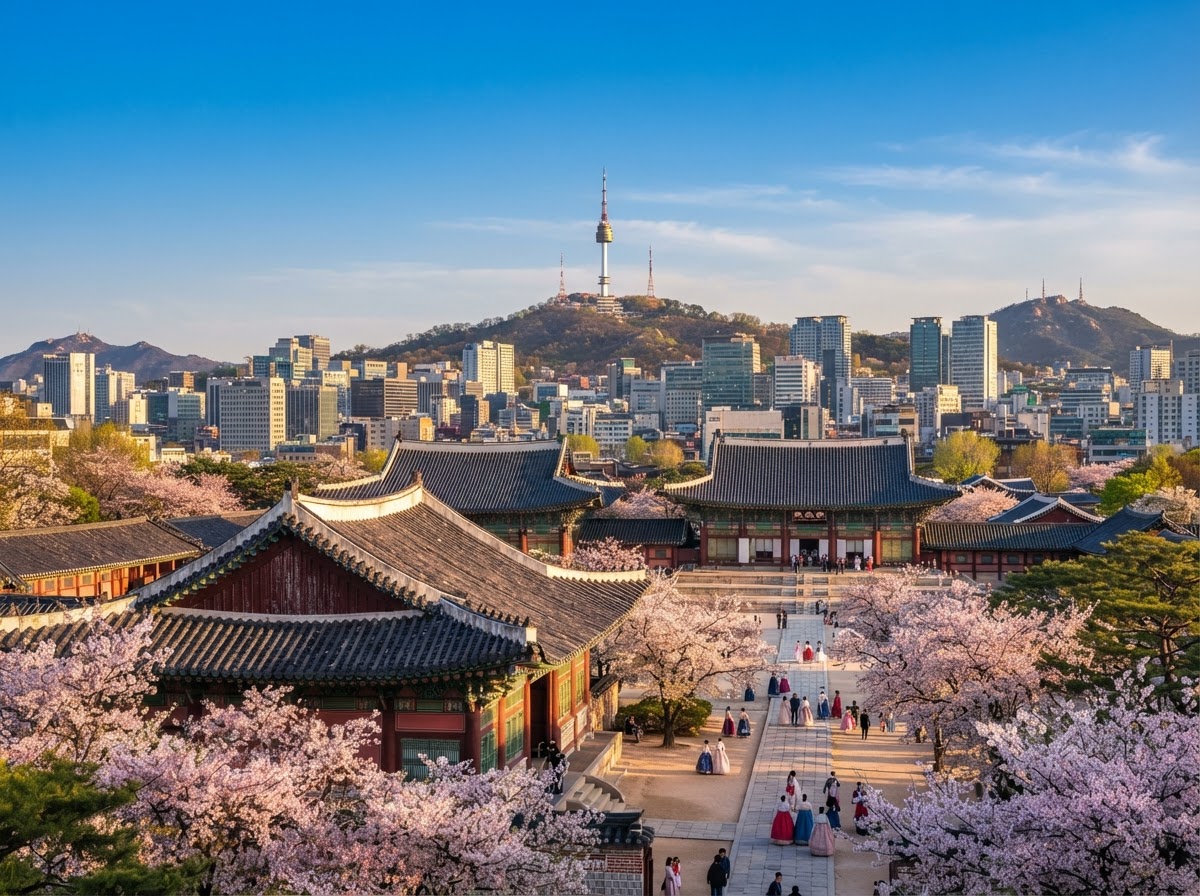
South Korea has four distinct seasons. Spring (April-June) is the most beautiful time, with cherry blossoms in early to mid-April and mild, pleasant weather — but it is crowded and more expensive. Autumn (September-November) is equally stunning, with clear skies, comfortable temperatures and red and golden leaves; it is the sweet spot for weather and crowds. Summer (July-August) is hot, humid and rainy, with a monsoon season in July, but it is beach season and festival time. Winter (December-February) is cold and dry, with snow in the north and mountains; it is the quietest time and the season for skiing, hot springs and winter illuminations. For Muslim travellers, autumn is the best balance of comfort, beauty and manageable crowds. Avoid the major Korean holidays — Lunar New Year (January-February) and Chuseok (autumn harvest festival, September-October) — when the whole country travels.
Getting to and around South Korea
Incheon International Airport (ICN), near Seoul, is the main international airport and one of the best in the world, with direct flights from across Asia, the Middle East, Europe and North America. Compare flights across providers. A pre-booked private transfer from Incheon to Seoul is the most convenient option, as the airport is about an hour from the city; compare transfer providers for fixed-price options. The Airport Railroad Express (AREX) is a fast, cheap alternative. South Korea's public transport is excellent — the Seoul subway is fast, clean and extensive, and high-speed KTX trains connect Seoul, Busan, Gyeongju and the major cities. T-Money cards cover subway, buses and trains. Car rental is an option for Jeju and the countryside; compare providers. South Korea is one of the easiest countries to travel in, thanks to the transport infrastructure.
Staying connected with an eSIM
South Korea has excellent mobile data coverage, and a travel eSIM is the easiest way to have data from the moment you land at Incheon. Compare data-only eSIMs from providers that cover South Korea, checking data allowances and validity. South Korean networks are fast and reliable. A single-country South Korea plan is usually cheapest; a regional Asia plan is better value if you are visiting several countries. A travel eSIM is essential for locating nearby halal restaurants and mosques on the go, especially outside Itaewon where options are scattered. Download offline maps and translation apps before you travel, and remember most travel eSIMs are data-only, so keep your home line active for SMS verification codes.
Muslim-friendly tips for South Korea
Base yourself in or near Itaewon in Seoul — it is the heart of the Muslim community, with the Seoul Central Mosque and the best halal restaurants. Download halal-finder and prayer-time apps before you travel. For Korean food, seek out certified halal Korean barbecue and bulgogi restaurants, and consider Buddhist temple food (plant-based, alcohol-free) as a reliable alternative. When booking hotels, ask about prayer mats and qibla direction. Carry a small travel prayer mat. Visit the Seoul Central Mosque — it is welcoming and a focal point. A travel eSIM helps you find halal food and mosques on the go, especially outside Seoul. With modest planning, South Korea is a safe, clean and deeply rewarding destination for Muslim travellers.
Protecting your trip
Travel insurance is recommended for South Korea — medical care is excellent but can be expensive for visitors. Compare policies and check what is included, particularly medical coverage. If your flight to or from South Korea is delayed, cancelled or overbooked, you may be entitled to compensation under applicable air passenger rights regulations; specialist services can check your eligibility and handle the claim with the airline on your behalf. Keep your boarding pass and booking reference until you are home.
Recommended Offers
Relevant offers for this trip. You'll be redirected to the partner to complete your booking.
Flights to Seoul
Check PriceTours & activities in Seoul
View DealsAttraction tickets in Seoul
View OfferExperiences & day tours in South Korea
View DealsCity passes & multi-attraction tickets
View PassesSelf-guided audio walks in Seoul
View OfferSeoul airport private transfer
Check PriceAirport transfer with English-speaking driver
View AvailabilityCompare airport transfer prices
Check PriceShared & private airport transfers
View OfferSouth Korea eSIM data
View DealUnlimited South Korea data eSIM
View DealFlexible global data eSIM
View DealPrepaid South Korea data eSIM
View DealLuggage storage in Seoul
View DealCar rental comparison in South Korea
Check PriceCar rental across South Korea
Check PriceCar hire with price-drop protection
Check PriceCar hire with AutoEurope
Check PriceLocal car rental in South Korea
Check PriceScooter & motorbike rental
Check PriceFlight delay compensation check
Check EligibilityFlight compensation claim service
Check EligibilitySome links may be affiliate links. JalanDeals may earn a commission when you book through selected partners.
Frequently Asked Questions
Is South Korea Muslim-friendly?
Yes, with planning. Seoul's Itaewon district is the Muslim hub, with the Seoul Central Mosque and the city's best halal restaurants. The number of halal-certified Korean restaurants is growing. Use halal-finder apps and base yourself near Itaewon in Seoul.
Where can I find halal Korean food?
Itaewon in Seoul has the most halal restaurants, including halal Korean barbecue, bulgogi and bibimbap. Look for certified restaurants around the Seoul Central Mosque. Buddhist temple food (plant-based, alcohol-free) is a reliable alternative across the country.
When is the best time to visit South Korea?
Autumn (September-November) is the sweet spot — clear skies, comfortable weather and beautiful autumn leaves. Spring (April-June) has cherry blossoms but is more crowded. Summer is hot and rainy; winter is cold but quiet with skiing and hot springs.
Are there mosques in South Korea?
Yes, around a dozen. The Seoul Central Mosque in Itaewon is the largest. Busan has the Al-Fatah Mosque. Incheon International Airport has a prayer room. Use mosque-finder and prayer-time apps, and carry a small travel prayer mat.
Which eSIM works in South Korea?
Compare data-only eSIMs from Airalo, Yesim, Drimsim and Saily that cover South Korea. Korean networks are fast and reliable. A travel eSIM is essential for finding halal restaurants and mosques on the go, especially outside Itaewon.
Is Jeju Island Muslim-friendly?
With planning. Jeju has limited halal food, so book accommodation that can cater to dietary needs and carry snacks. The natural beauty — volcanoes, waterfalls and beaches — makes it worth the extra effort. Pray in your hotel room and use a travel prayer mat.
Explore more
Related destination hubs and deal categories for this trip.
Destinations
Affiliate disclosure: This article contains affiliate links. JalanDeals may earn a commission when you book through selected partners, at no additional cost to you. Prices and availability are set by the provider.