
In this article
- 1. Why Petra and Jordan deserve the journey
- 2. The Siq and the Treasury
- 3. Beyond the Treasury — the city of Petra
- 4. The Monastery and the hikes
- 5. Petra by Night
- 6. Wadi Rum — the desert moonscape
- 7. The Dead Sea, Jerash and Aqaba
- 8. Where to stay
- 9. When to visit Jordan
- 10. Getting to Jordan and Petra
- 11. Getting around Jordan
- 12. Staying connected with an eSIM
- 13. Muslim-friendly travel in Jordan
- 14. Protecting your trip
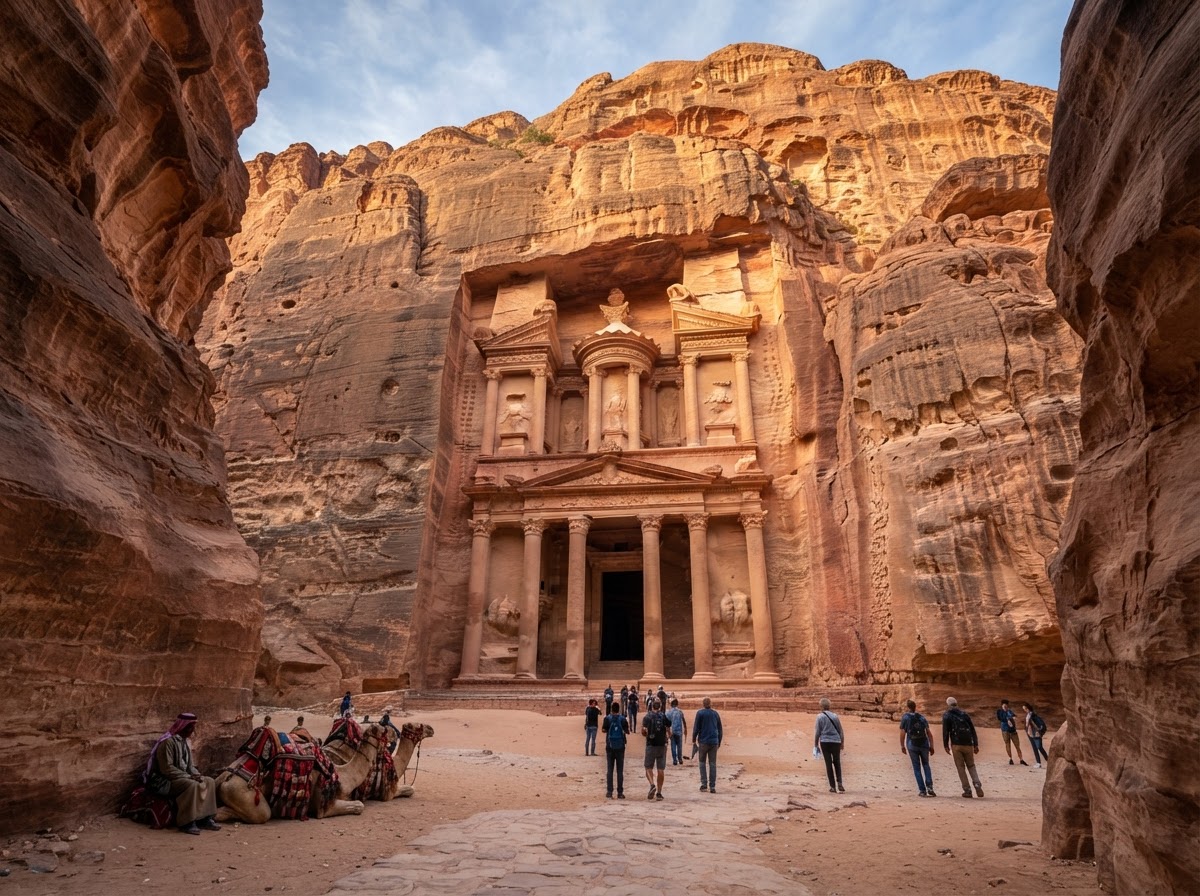
Petra is one of the world's great archaeological wonders — a city carved directly into rose-red sandstone cliffs by the Nabataeans more than 2,000 years ago, lost to the West for centuries and rediscovered in 1812. Walking the narrow Siq canyon to emerge before the glowing facade of the Treasury is one of travel's great moments. But Petra is also the gateway to a small country with an outsized range of experiences: the moonscape of Wadi Rum, the floating waters of the Dead Sea, the Roman ruins of Jerash and the welcoming culture of the Jordanian people. This guide covers what to see, where to stay, when to go, how to get around, how to stay connected and how to compare current offers from multiple travel brands before completing your booking with a partner.
Why Petra and Jordan deserve the journey
Jordan is a small country that packs in an extraordinary range of experiences. In a week you can walk among the carved facades of Petra, sleep under the stars in the desert of Wadi Rum, float in the salty Dead Sea, explore one of the best-preserved Roman cities in the world at Jerash, and dive in the Red Sea at Aqaba. It is safe, welcoming and well-organised for tourism, with a culture of hospitality that makes solo and family travel easy. Petra itself is the headline, but the country around it is what makes the trip memorable.
The Siq and the Treasury
The classic Petra experience begins with the walk down the Siq — a 1.2km narrow canyon between towering sandstone walls, in places only 3m wide. The walk builds anticipation, and then the canyon opens to reveal the Treasury (Al-Khazneh), the 40m-high facade carved into the cliff face, glowing rose-red in the morning sun. It is one of the most dramatic reveals in travel. Arrive early — the site opens around 6am — to have the Siq and the Treasury almost to yourself before the tour groups arrive. The Treasury is a tomb, not a treasury (the name came from a legend that pirates hid gold in the urn at the top), and the interior is small. The best photos are from the clearing just as you exit the Siq.
Beyond the Treasury — the city of Petra
Petra is far more than the Treasury. The site is vast — a whole city spread over several kilometres. The Street of Facades is a row of carved tombs. The Theatre, carved into the hillside, held 8,000 spectators. The Royal Tombs are a series of impressive facades along the cliff. The Colonnaded Street was the Roman-era main street. The Petra Church has fine mosaics. Allow a full day to explore the main areas, and a second day if you want to do the longer hikes. The site is mostly unpaved and dusty, so wear sturdy shoes, bring water and a hat, and start early to beat the heat.
The Monastery and the hikes
The Monastery (Ad-Deir) is Petra's other great facade — larger than the Treasury but less ornate, and reached by a steep climb of around 800 steps. The climb takes 45 minutes to an hour and is best done early or late in the day. The reward is the huge facade and, from the nearby cliff, a view over the Wadi Araba desert. For serious hikers, the High Place of Sacrifice offers panoramic views over the site, and the Little Petra (Siq al-Barid) site, a few kilometres away, is a smaller, quieter version of Petra worth a short visit. There are also longer trails to the far reaches of the site for those with time and energy.
Petra by Night
Petra by Night is a special experience offered on certain evenings (usually Monday, Wednesday and Thursday — check current schedule). The Siq and the area in front of the Treasury are lit by hundreds of candles, and Bedouin musicians play traditional music. It is a quiet, atmospheric 90 minutes and a completely different experience from the daytime visit. Book in advance. Bring a torch for the walk back up the Siq. It is weather-dependent and can be cancelled in heavy rain. Even if you don't do the official night, walking the Siq at dawn or dusk is magical.
Wadi Rum — the desert moonscape
Wadi Rum, about 1.5 hours south of Petra, is a protected desert of red sand dunes, sandstone mountains and rock arches — the landscape used in many films set on Mars. The classic experience is a 4x4 jeep tour with a Bedouin guide, visiting natural arches, rock carvings, sand dunes and viewpoints, and ending with a sunset over the desert. Many visitors stay overnight in a Bedouin camp, sleeping under the stars (or in a tent) and eating a traditional zarb meal cooked underground. Book a tour or camp through a reputable operator — compare options across providers. Wadi Rum is best in the cooler months; in summer it is extremely hot.
The Dead Sea, Jerash and Aqaba
The Dead Sea, the lowest point on earth at 430m below sea level, is famous for its hypersaline water in which you float effortlessly, and its mineral-rich mud. The Jordanian side has resort hotels and public beaches. Don't shave before you swim — the salt stings. Jerash, north of Amman, is one of the best-preserved Roman cities anywhere, with a colonnaded street, two theatres and a stunning oval forum — a half-day trip from Amman. Aqaba, on the Red Sea, is Jordan's beach and diving resort, with coral reefs and warm water. Each of these can be combined with Petra in a one-week circuit.
Where to stay
For Petra, the town of Wadi Musa is the base, with hotels from budget to luxury clustered near the visitor entrance. Many visitors stay two nights to allow a full day in the site and a second day for the longer hikes. For Wadi Rum, stay in a Bedouin camp inside the protected area for the full experience. Amman has the full range of city hotels and is the usual entry point. The Dead Sea has resort hotels. Aqaba has beach and diving hotels. Compare hotel options across booking platforms to find the right balance of location, price and style for your trip.
When to visit Jordan
The best times are spring (March to May) and autumn (September to November), when the weather is mild and the desert is comfortable. Summer (June to August) is very hot, especially in Wadi Rum and the Dead Sea, where temperatures can exceed 40°C — early-morning and evening activities are the only comfortable options. Winter (December to February) is cold, especially at night in the desert and in Petra, which can see snow, but the sites are quiet. Avoid the Jordanian school holidays and the Eid periods if you dislike crowds. Whenever you go, bring layers — the desert is hot by day and cold at night.
Getting to Jordan and Petra
Most visitors fly into Queen Alia International Airport (AMM) in Amman. Compare flights across providers — Amman is connected across the Middle East and Europe. From Amman, Petra is about 3 hours south by road. A pre-booked private transfer is the most convenient option, especially for a group; compare transfer providers for fixed-price options. The JETT bus runs daily from Amman to Petra. Many visitors rent a car — driving in Jordan is on good roads and is straightforward, though the desert roads to Wadi Rum should be done with care. Compare car rental options if you plan to explore independently.
Getting around Jordan
Jordan is best explored by car or with a driver. The main roads are good and well-signed. A rental car gives the most flexibility for the Petra–Wadi Rum–Dead Sea circuit; compare car rental options. Alternatively, a private driver or a booked tour handles everything and is good value for a group. Public transport exists between the main cities but is limited for the sights. For Petra itself, the site is walked (or you can hire a donkey or camel for parts). Inside Wadi Rum, you need a 4x4 with a Bedouin guide. Build in buffer time — distances are not huge but the terrain is slow.
Staying connected with an eSIM
Jordan's mobile networks are decent in the cities and along the main highways, but coverage in Petra, Wadi Rum and the desert can be patchy. A travel eSIM is the easiest way to have data from the moment you land. Compare data-only eSIMs across providers, checking coverage in the areas you plan to visit, data allowances and validity. Download offline maps for Petra and Wadi Rum before you leave the city. A single-country Jordan plan is usually cheapest; a regional Middle East plan is better value if you are combining Jordan with neighbouring countries. Remember that most travel eSIMs are data-only, so keep your home line active for SMS verification codes.
Muslim-friendly travel in Jordan
Jordan is a Muslim-majority country and one of the most comfortable destinations in the region for Muslim travellers. Halal food is the norm — the national dish mansaf (lamb in yogurt sauce over rice) is a must-try, and falafel, hummus, shawarma and mezze are everywhere. Mosques are plentiful in every town, and prayer facilities are available at the airport and major hotels. Alcohol is available in hotels and licensed restaurants for non-Muslim visitors but is not part of mainstream culture. Dress modestly outside the beach resorts. During Ramadan, daytime eating in public is limited, but tourist hotels continue to serve, and iftar is a wonderful experience. Jordan is safe, family-friendly and famously hospitable.
Protecting your trip
Travel insurance is recommended for Jordan — medical care at private facilities is good but can be expensive, and the desert and hiking activities carry some risk. Compare policies and check what is included, particularly coverage for hiking and 4x4 activities. If your flight to or from Amman is delayed, cancelled or overbooked, you may be entitled to compensation under applicable air passenger rights regulations; specialist services can check your eligibility and handle the claim with the airline on your behalf. Keep your boarding pass and booking reference until you are home.
Recommended Offers
Relevant offers for this trip. You'll be redirected to the partner to complete your booking.
Flights to Petra
Check PriceTours & activities in Petra
View DealsAttraction tickets in Petra
View OfferExperiences & day tours in Jordan
View DealsCity passes & multi-attraction tickets
View PassesSelf-guided audio walks in Petra
View OfferPetra airport private transfer
Check PriceAirport transfer with English-speaking driver
View AvailabilityCompare airport transfer prices
Check PriceShared & private airport transfers
View OfferJordan eSIM data
View DealUnlimited Jordan data eSIM
View DealFlexible global data eSIM
View DealPrepaid Jordan data eSIM
View DealLuggage storage in Petra
View DealCar rental comparison in Jordan
Check PriceCar rental across Jordan
Check PriceCar hire with price-drop protection
Check PriceCar hire with AutoEurope
Check PriceLocal car rental in Jordan
Check PriceScooter & motorbike rental
Check PriceFlight delay compensation check
Check EligibilityFlight compensation claim service
Check EligibilitySome links may be affiliate links. JalanDeals may earn a commission when you book through selected partners.
Frequently Asked Questions
How many days do I need for Petra and Jordan?
Two days at Petra, one night in Wadi Rum, and a day each for the Dead Sea and Jerash makes a comfortable one-week circuit from Amman.
When is the best time to visit Petra?
Spring (March-May) and autumn (September-November) are mild and comfortable. Summer is very hot; winter is cold and can snow. Start early in the day to beat the heat and crowds.
How do I get to Petra?
Fly into Amman, then it's about 3 hours south by road. A pre-booked private transfer is easiest; the JETT bus runs daily; or rent a car for the full circuit.
Is Jordan Muslim-friendly?
Very. Jordan is Muslim-majority, halal food is the norm, mosques are everywhere, and the culture is famously hospitable. Ramadan is a special time to visit.
Do I need a visa for Jordan?
Jordan offers visa-on-arrival or the Jordan Pass (which includes the visa and Petra entry) to many nationalities — check the official Jordanian tourism guidance for your passport before travel.
Which eSIM works in Jordan?
Compare data-only eSIMs from Airalo, Yesim, Drimsim and Saily that cover Jordan. Coverage in Petra and Wadi Rum can be patchy, so download offline maps.
Explore more
Related destination hubs and deal categories for this trip.
Deal categories
Affiliate disclosure: This article contains affiliate links. JalanDeals may earn a commission when you book through selected partners, at no additional cost to you. Prices and availability are set by the provider.